
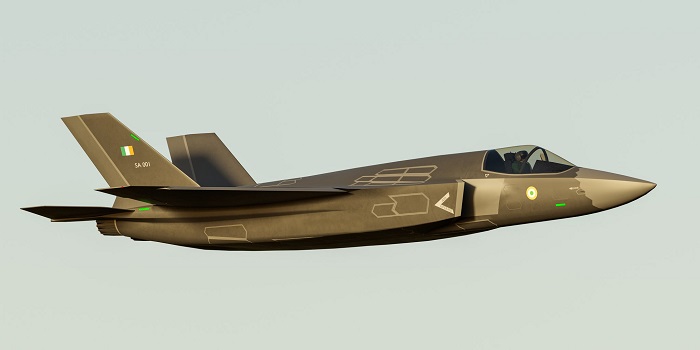
The effort is being led by India’s Defence Research and Development Organisation and Hindustan Aeronautics Limited. The Advanced Medium Combat Aircraft (AMCA) program has its roots in an Indian effort to modernize the Indian Air Force’s (IAF) stock of older fighters, including the SEPECAT Jaguar and Dassault Mirage 2000. The AMCA project has undergone multiple iterations, but the core requirement is for a stealth, single-seat multi-role multirole fighter.
In 2018, India withdrew from the joint Russian-Indian Fifth Generation Fighter Aircraft (FGFA) program to manufacture a new fighter based on Russia’s Su-57 fighter jet. Though the IAF had its share of concrete technical reservations with the FGFA—centered mainly on the Su-57’s stealth performance and the production challenges facing its bespoke Izdeliye 30 engine—New Delhi’s decision to withdraw from the FGFA program was not without its political context. Namely, the FGFA partnership gradually became a liability in light of India’s goal to build up its domestic defense industry as part of the government’s 2014 Make in India initiative.





The AMCA, then, is as much a technical project as it is part of New Delhi’s broader policy effort to reinvest in India’s defense sector. The effort is being led by India’s Defence Research and Development Organisation and Hindustan Aeronautics Limited and is likewise slated to involve efforts from local contractors.
The details have shifted somewhat in the past decade, but here is where the AMCA project currently stands. As a fifth-generation fighter with “sixth-generation characteristics,” the AMCA will boast a very low radar cross-section for superior stealth performance, integration of certain AI-based systems for streamlined operation, and an advanced cockpit display with a touch screen interface. The AMCA’s avionics suite will be headlined by a large suite of advanced radars and electronic warfare systems.
The AMCA will also reportedly feature thrust-vectoring engines for superior maneuverability, an impressive feat considering all the other advanced technologies being packed into it. Little is known about the AMCA’s armaments, which reportedly will be carried entirely in an internal weapons bay configuration to maximize stealth performance and deep penetration capability. The fighter will feature Beyond-Visual Range missile targeting capability. In addition to the usual crop of air-to-air missiles, standoff weapons, and guided bombs, the fighter will also reportedly support directed-energy weapon (DEW) systems; it is unknown precisely what form the fighter’s rumored DEW capability will take.
The AMCA seems more similar to Lockheed Martin’s F-35 jet than to Russia’s Su-57 jet or China’s J-20 jet, in that it’s designed as a role-flexible fighter capable of executing a wide range of missions depending on loadout. The AMCA appears to be a complement rather than a replacement, for the IAF’s air superiority fighters, serving as a flexible force multiplier with superior penetration capabilities.
The IAF’s delivery timeline is liable to change in the coming years as the project moves further along, but the AMCA is currently expected to make its maiden flight by 2025, with serial production to begin by 2028.

