
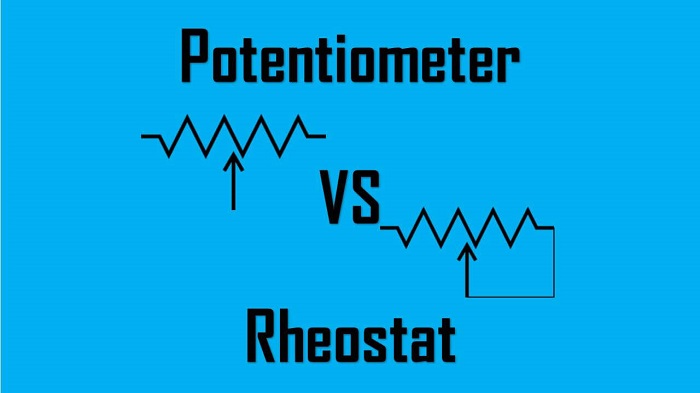
You’re building a circuit, and you need to introduce a fixed amount of resistance on a particular length of wire. That’s easy, you might think: just insert a resistor of the required value. But what if you need the amount of resistance to vary depending on the circumstances? In this case, you’ll need a variable resistor.
Variable resistors come in a number of different shapes and sizes. If you need the resistance to change depending on the local temperature, then you’ll need to use something called a thermistor. But what if you want the user to be able to adjust the temperature, using a knob or a slider? In this instance, you’ll need one of two devices: a potentiometer, or a rheostat. In practice, as we’ll see, these are often the same device, wired differently.




What’s a rheostat?
A rheostat is a kind of resistor used to vary the current available at a given point in a circuit. By changing the amount of resistance, in accordance with Ohm’s law, we can bring the level of current up or down. Rheostats are simple devices which can be purchased inexpensively.
What’s a potentiometer?
A potentiometer works much the same, except we’re creating two resistors, with the output coming between the two. By moving a conductive slider across a resistive strip, we can change the configuration of the resulting voltage divider on the fly. In most cases, a signal will come in one side of the potentiometer, and the other side will be connected to ground. By adjusting the potentiometer, we can attenuate the signal.
Are the two interchangeable?
A potentiometer has three terminals. One connects to one side of the resistor, a second connects to the other, and a third sits in the middle, on an adjustable slider. This effectively means that a potentiometer can double as a rheostat: we just connect up the slider, and then either of the other pins. Depending on which one you choose, you’ll be able to reverse the effective direction of the knob or slider.
On the other hand, rheostats can’t be used as potentiometers, since they only have two terminals.
Digital Alternatives
A digital potentiometer or rheostat doesn’t work in the same way. Rather than attenuating a voltage or current, it will instead send out a digital value, in the form of a stream of encoded pulses. This is great for applications where values need to be recalled, or for when high precision is required.
Physical Configuration
Both rheostats and potentiometers can come in either rotary or linear configurations. In some applications, sliders might be more appropriate than knobs. For example, if you’re creating a mixing desk, or a graphic equaliser, where multiple values might need to be entered simultaneously, often with a single hand. In devices where physical space is at a premium, however, you might prefer to use rotary potentiometers or rheostats. You might think of the bank of knobs that sit on the top of a mixing desk.

