

Transistors, devices that can amplify, conduct or switch electronic signals or electric current, are key components of many electronics on the market today. These devices can be fabricated using a variety of inorganic and organic semiconducting materials.
Metals are generally considered unsuitable for fabricating transistors, as they screen electric fields and thus make it difficult to realize devices with tunable electrical conductivity. A possible way to create electronic components based on metals is to use gradients of counterions in films of metal nanoparticles functionalized with charged organic ligands.



In the past, engineers have successfully used this strategy to create a variety of devices, ranging from resistors to diodes and sensors. Nonetheless, modulating the electrical conductivity of these devices has often proved to be very challenging.
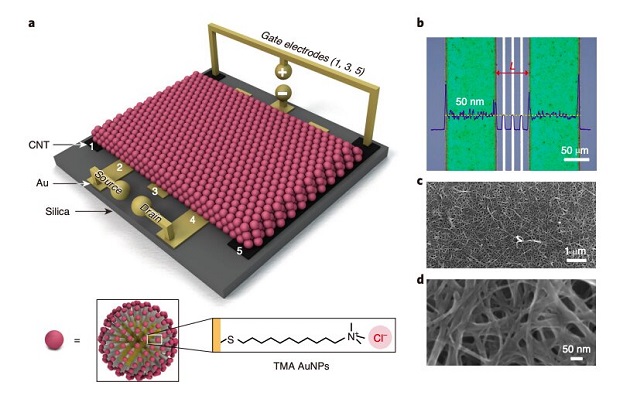
Researchers have recently introduced a new design strategy to create transistors and logic circuits with tunable electrical conductivity based on metal nanoparticles.
Transistors and logic circuits can be created from thin films of functionalized gold nanoparticles using dynamic ionic gradients established via an unconventional five-electrode configuration. The transistors are capable of a 400-fold modulation of electrical conductivity and by combining them with metal nanoparticle diodes and resistors, can be used to construct NOT, NAND, and NOR logic gates, as well as a half-adder circuit.
Past studies have shown that logic circuits made of metal nanoparticles are significantly slower than silicon-based devices. Nonetheless, they also have a number of advantageous characteristics. For instance, they can operate in humid/wet environments, are fairly flexible, and can endure electrostatic discharges, which can damage silicon-based devices.
In initial evaluations, the new transistor performed remarkably well. In addition to having a tunable electrical conductivity, the transistor can withstand electrostatic discharges. Moreover, it continues operating well when it is deposited on flexible substrates and these structures are stretched or deformed.
To create their device, the team deposited electrodes on a flexible polyethylene terephthalate (PET) film. So far, they have only created a prototype or proof-of-concept version of the transistor to evaluate its advantages. To be integrated into real electronic devices, however, it will first need to be developed and tested further.
While the device is inherently limited in that the source/drain voltage must be lower than the gate voltage (or else the Cl− concentration profile would be altered), the speed of operation may be improved. Previously, all-metal-nanoparticle diodes that when the distances over which the counterion gradients form are around 1μm, the switching times can be in milliseconds. Similar gains can be envisioned for the transistor architecture, although the requisite miniaturization will probably require professional fabrication facilities beyond the reach of academic labs.

