
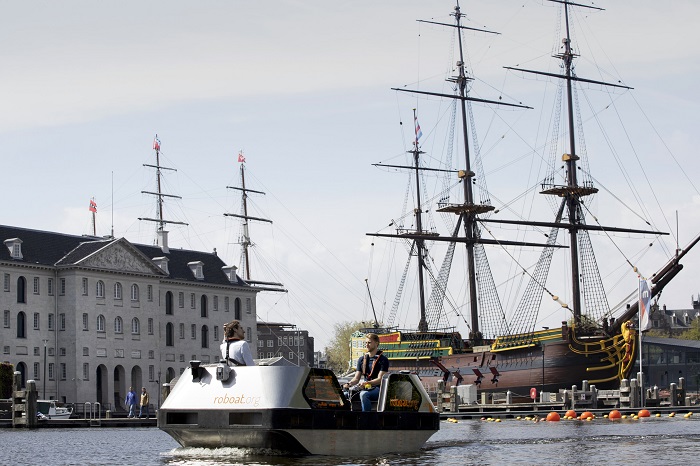
Amsterdam didn’t have to look very far when searching for a way to ease traffic on its congested streets. The Dutch capital’s canals were used for transport long before cars and trucks powered by polluting internal combustion engines began clogging its narrow roads.
Already steeped in maritime history, the city’s more than 100 kilometers (60 miles) of waterways are to start hosting prototypes of futuristic boats—small, fully autonomous electric vessels—to carry out tasks including transporting passengers and picking up garbage.




The Amsterdam Institute for Advanced Metropolitan Solutions and the Massachusetts Institute of Technology are collaborating on the Roboat project that aims to develop new ways of navigating the world’s waterways without a human hand at the wheel.
Stephan van Dijk, director of innovation at the Amsterdam institute, said the technology is “very relevant in highly complex port operations, where you have a lot of vessels and a lot of ships and a lot of quays and piers. There you can really improve the safety with autonomous systems, but also make it more efficient and into 24/7 operations approach.”
At a recent demonstration, one 4-meter (13-foot) long electric boat sailed past a full-size replica of the 18th-century three-mast trading ship Amsterdam, providing a snapshot of the city’s nautical past and its future.
Next, it has to learn to maneuver through traffic in Amsterdam’s canals, which are full of private boats and canal cruises for tourists.
The Roboats have orange propellers and four thrusters that are powered by an electric battery. They can go about 4 mph (6 kph) and can run for 12-24 hours, depending on the battery type and cargo load.
They are steered remotely by a computer, which processes data from cameras and sensors that scan the areas around the vessel, detecting stationary and moving objects. The vessels are modular so they can be easily adapted for different purposes, carrying cargo or workers.
“It’s mostly because we want to be absolutely sure that we can navigate safely in the canals,” said mechatronics engineer Rens Doornbusch. “Right now we have the autonomy in place, but one of the next steps is to make sure that we can actually handle any kind of situation that we might encounter in the canals.”
Before the boats can be put to work, their developers also have to navigate legislative hurdles and privacy concerns.
“We are actively working together with the ministries and the legislators to identify what specific legal aspects have to be changed to allow for fully autonomous operation,” Van Dijk said.
He says the boats’ use of data from its cameras and scanners has been developed “in such a way that we are not identifying any persons that are walking on the roads. So in that sense, privacy is being secured.”

