
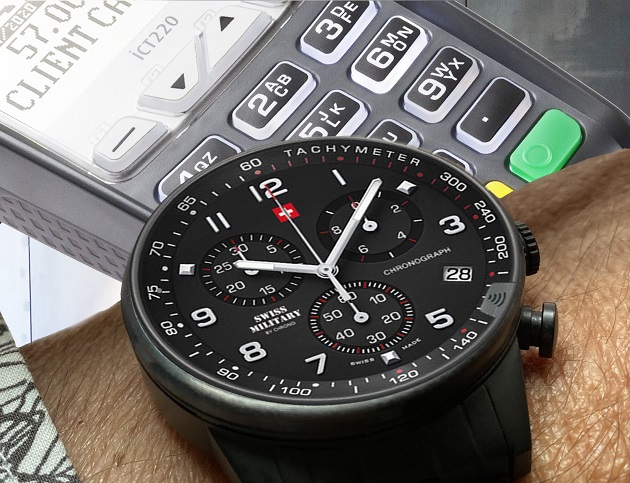
More and more people around the world are paying with contactless because it’s easy, fast and hygienic. Especially in the wake of the Corona pandemic, the acceptance and spread of the technology has accelerated significantly. In addition to ATM or credit cards, so-called wearables are also in high demand. For the first time, it is now possible to equip traditional wristwatches or luxury models made of metal with the contactless payment function. The Swiss company Winwatch integrates tiny security chips from Infineon Technologies AG (FSE: IFX / OTCQX: IFNNY) almost invisibly into its patented sapphire crystal STISS® for this purpose. The chip enables fast and secured payment transactions by radio frequency within milliseconds.
“A fast and robust connection from the watch to the reader at the checkout is crucial for customer acceptance,” says Alex Kalbermatten, CEO of Winwatch. “Infineon surpasses all other solutions currently available on the market in terms of wireless quality. For example, by integrating the contactless chip we were able to develop a sapphire crystal that turns every watch – from mechanical heirlooms to metal sports watches – into a contactless payment device. And all of this without a battery.”




“Whether with a classic card, a fashion accessory such as a ring or smart wearables – chip innovations from Infineon combine the real and the digital world and enable simple, secured and hygienic payment transactions,” says Björn Scharfen, Head of the product line Payment & Ticketing Solutions at Infineon. With our security and contactless expertise as well as energy-efficient chip design, we play a leading role in this growth market”.
The most widely used contactless payment method is still the credit or debit card. According to ABI, already two thirds of all cards used today are contactless. Their share is expected to grow to more than 80 percent by 2025. The market researchers estimate another 1.9 billion contactless cards to be shipped in 2020 worldwide. The demand for wearables with a payment function is also growing continuously. According to a study more than 75 percent of all Mastercard transactions in Europe are now contactless. Payment transactions with smartphones and wearables have doubled within a year from seven to 14 percent.
With a market share of more than 47 percent*, Infineon is the world’s number 1 in payment chips for cards and the leader in contactless technologies. The Munich-based semiconductor manufacturer operates its own competence center for contactless technologies in Graz, Austria.
Combination of chip technology, data security and antenna design
Contactless payment solutions require a triad of semiconductor technology, encryption and analog radio technology. Whether card, watch, ring or key fob, the integrated chip plays a central role.
It is a mini-computer measuring just a few square millimeters that initiates and controls all communication between the customer and the financial institute via a small antenna. Within around 200 milliseconds – the blink of a human eye – the chip proves the authenticity of the device with an individual signature and creates a cryptogram of card data, payment amount and place of payment. After successful verification, the bank confirms the payment to the reader.
Communication between the card or wearable and the reader is based on NFC (Near Field Communication) technology. At a distance of two to ten centimeters, the chip uses only the energy field of the reader to calculate, encrypt and transmit the data.

