
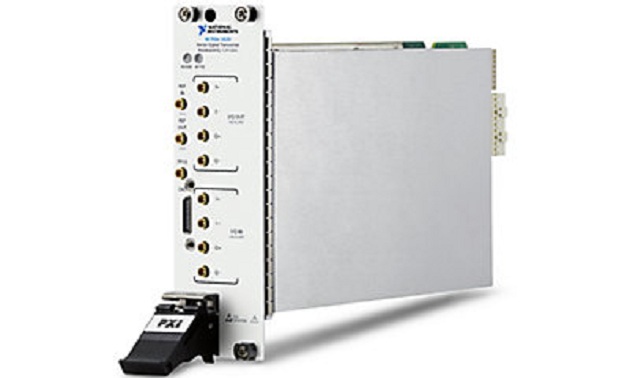
NI, the provider of platform-based systems that enable engineers and scientists to solve the world’s greatest engineering challenges, announced a baseband model of the second-generation Vector Signal Transceiver (VST). The PXIe-5820 module is the industry’s first baseband VST with 1 GHz of complex I/Q bandwidth and is designed to address the most challenging RF front-end module and transceiver test applications, such as envelope tracking, digital pre-distortion and 5G tests.
“In 2016, NI disrupted the industry by introducing the RF model of our second-generation VST with 1 GHz of instantaneous bandwidth,” said Charles Schroeder, vice president of RF and wireless at NI. “We’re continuing the disruption with the baseband model of our second-generation VST. Engineers can use the baseband VST with Lab VIEW system design software to address the evolving and changing needs of transceiver test applications. Engineers can take advantage of the software-designed architecture of NI’s VSTs to help accelerate the pace of design, reduce the cost of test and solve measurement problems previously unsolvable through traditional test approaches.”




The PXIe-5820 combines a wideband I/Q digitizer, wideband I/Q arbitrary waveform generator and high-performance user-programmable FPGA into a single 2-slot PXI Express module. With 1 GHz of complex I/Q bandwidth, the baseband VST suits a wide range of applications including baseband I/Q testing of wireless and cellular chipsets as well as envelope tracking of digitally pre-distorted waveforms for power amplifier, and generation and analysis of new wireless standards such as 5G, 802.11ax and LTE-Advanced Pro.
Product Features:
- 1 GHz of complex I/Q instantaneous bandwidth for generation and analysis
- Measurement accuracy to measure 802.11ax error vector magnitude (EVM) performance of -54 dB
- Baseband 2-channel differential I/Q with 4 Vpp differential input and 2 Vpp differential output swing
- FPGA-based measurement acceleration for measurements up to 10X faster and highly optimized measurement software
- Compact size and tight synchronization of baseband and RF VSTs allowing for 2×2, 4×4, 8×8 or higher multiple input, multiple output (MIMO) configurations in the PXI form factor
- Excellent noise floor and spurious free dynamic range
- User-programmable FPGA that engineers can customize to add application-specific functionality
- Ease of programming with consistent software experience between RF and baseband VSTs
“The baseband VST is a deliberate evolution of our original software-designed architecture,” said Ruan Lourens, chief architect of R&D, RF at NI. “We have managed to optimize in every possible domain, from thermal and electrical to digital signal processing, to successfully deliver 1 GHz complex I/Q bandwidth in a small form factor. The baseband VST can be tightly synchronized with the PXIe-5840 RF VST to sub-nanosecond accuracy, to offer a complete solution for RF and baseband differential I/Q testing of wireless chipsets.”
The baseband VST is a vital part of the NI platform and ecosystem that engineers can use to build smarter test systems. These test systems benefit from more than 600 PXI products ranging from DC to mm Wave. They feature high-throughput data movement using PCI Express Gen 3 bus interfaces and sub-nanosecond synchronization with integrated timing and triggering. Users can take advantage of the productivity of the LabVIEW and Test Stand software environments, along with a vibrant ecosystem of partners, add-on IP and applications engineers, to help dramatically lower the cost of test, reduce time to market and future-proof testers for tomorrow’s challenging requirements.

