
To discover a prominent breakthrough in de-icing technology, engineers at UBC Okanagan have been collaborating with researchers from the University of Toronto
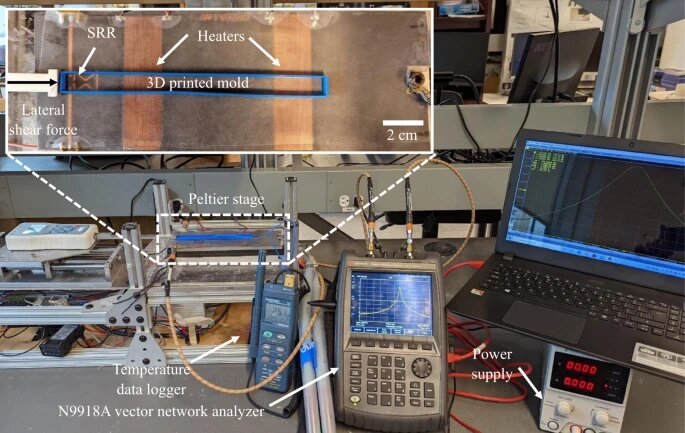
Their latest research examines a smart, hybrid—meaning passive and also active—a de-icing system that works by combining an interfacial coating with an ice-detecting microwave sensor.




This coating integrates the sensors into the material while enabling heat to dislodge ice without the need for a person or machine to physically melt it, explains UBCO’s Dr Mohammad Zarifi.
“Many of us have had the misfortune of sitting on a plane waiting for it to be de-iced while fretting about missing a connecting flight,” says Dr Zarifi an Associate Professor at UBCO’s School of Engineering and report co-author. “Our new technology takes a hybrid approach by adding sensors within an ice repellent coating that can easily be added to aviation or wind turbine blades.”
Dr Zarifi explains that undesired ice accumulation is problematic with many renewable energy technologies such as wind turbines and hydroelectric dams, aviation and power transmission. Ice mitigation strategies can be divided into either active or passive methods. Active de-icing involves an external energy input used to remove the ice, typically through thermal, chemical or mechanical methods. In contrast, passive de-icing either reduce the accretion rate of ice, lowers the adhesion strength between ice and the surface or both.
“Neither route towards an ice-free surface is seen as a cure-all today, as active de-icing methods utilize substantial energy but passive de-icing coatings cannot keep a surface ice-free indefinitely,” he adds. “A hybrid system that combines passive and active de-icing technologies may be an attractive solution to the ice-accretion problems.”
This is why the sensor—which lives beneath the coating that will be applied to a turbine or aircraft—could be a game-changer. The sensor acts as an ice detector and prompts the embedded heaters to melt the ice automatically.
This creates a substantial improvement in energy efficiency and is what sets this latest innovation apart from existing approaches, says Zahra Azimi Dijvejin, doctoral student and lead author of the study.
“The hybrid approach allows the operator to quickly and accurately monitor the equipment sustainably,” she says. “The equipment won’t need to be de-iced unnecessarily—avoiding wear-and-tear and wasteful energy usage—because the sensors can determine the need.”
The sensors, which are integrated into innovative materials, could keep surfaces ice-free without the need for further chemicals or energy-intensive methods.
“We are moving from our experimentation phase into real-life usage, and have seen the technology hold up to harsh conditions,” explains Dr Zarifi. “We’re currently working with Canadian turbine manufacturers to incorporate the technology for the upcoming winter.”

