
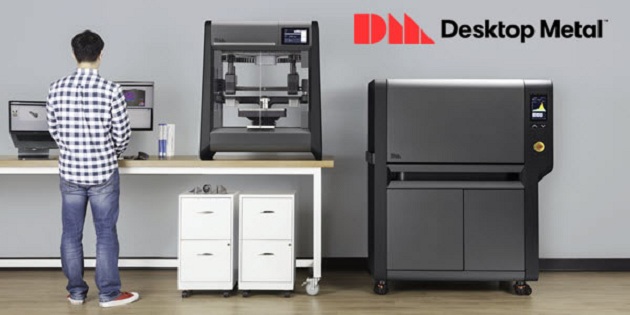
The Massachusetts-based company, Desktop Metal is preparing a 3D metal printing system which is much cheaper, faster, and safer than the existing printing systems which will compete with mass manufacturing processes.
Desktop Metal Founding Story




Desktop Metal was started to address a problem—how to make metal 3D printing accessible for engineering teams. In 2013, CEO Ric Fulop began collaborating with world-leading experts in materials science, engineering, and 3D printing. Their work together over the course of two years drew multiple independent inventions together to form the basis for Desktop Metal’s technology:
1988
“3D Printing” gets its name and Binder Jetting is invented by Ely Sachs (Co-founder) and colleagues at MIT
1997
Metallurgy experts Animesh Bose (VP, R&D) and Randall German publish definitive book on Metal Injection Molding
2000
Single-Pass Inkjet Technology is invented by Paul Hoisington (Chief Scientist for Inkjet Systems) and colleagues
2006-2011
Major nanocrystalline and amorphous metals advances are made by Chris Schuh (Co-founder) at MIT
2015
Desktop Metal is founded
The Studio System
Talking about studio, It is 10x cheaper than laser system which have same equal features and size. Their studio machines are also very practical to be in an office. They can be fitted almost anywhere without installation of ventilation or using respirators. They are also very low maintenance and doesn’t require any special support equipment or any extra staff.
The Studio printer runs around and prints parts into layers of bound metal. The parts then go into a de-binding bath that removes a good portion of the binding polymer, and then the parts go into a sintering furnace.
The furnace is the special sauce in the process. It uses a combination of regular heating elements and microwave heating to bring the part up to a temperature just below its melting point, where the binding agent burns off and the metal particles within fuse to their neighbors to produce a highly dense, sintered metal.
Timing and temperature are managed by the system, depending on the design and the metals used. Parts may shrink up to 15 percent at time of debinding and sintering process. At the end of the process, you have to basically poke out the support sections with a screwdriver. They’re not welded to the part, and in some cases can be broken off by hand. This studio system makes rapid and affordable metal prototyping to be more accessible. This system and software retails at US $120,000. The production system will debut in 2018, is where the real revolution could lie.
The Production System
The production system is developed for speed. Faster than machining, casting, forging or any other technique, each production printer can produce up to an incredible 500 cubic inches of complex parts per hour which is 100x quicker than a laser-based printer, with zero tooling. The Production printers use a different process called Single Pass Jetting. The Production machines use powders, which are bonded together during printing by spray-jetted droplets of a binder solution. They use regular, low-cost, easily available MIM powders.
Print resolution is as fine as 50 microns. Each printer will retail for around US$360,000.

