
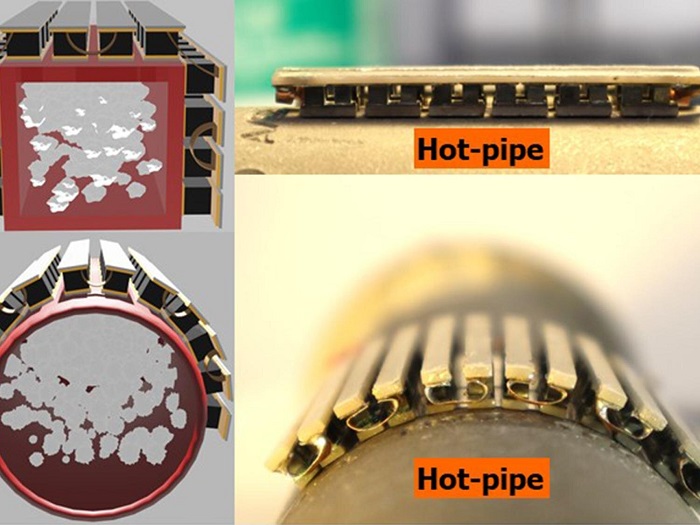
The energy systems that power our lives also produce wasted heat—like heat that radiates off hot water pipes in buildings and exhaust pipes on vehicles. A new flexible thermoelectric generator can wrap around pipes and other hot surfaces and convert wasted heat into electricity more efficiently than previously possible, according to scientists at Penn State and the National Renewable Energy Laboratory.
“A large amount of heat from the energy we consume is essentially being thrown away, often dispersed right into the atmosphere,” said Shashank Priya, associate vice president for research and professor of materials science and engineering at Penn State. “We haven’t had cost-effective ways with conformal shapes to trap and convert that heat to useable energy. This research opens that door.”




Penn State researchers have been working to improve the performance of thermoelectric generators—devices that can convert differences in temperature to electricity. When the devices are placed near a heat source, electrons moving from the hot side to the cold side produce an electric current, the scientists said.
In prior work, the team created rigid devices that were more efficient than commercial units in high-temperature applications. Now the team has developed a new manufacturing process to produce flexible devices that offer higher power output and efficiency, the scientists said.
“These results provide a promising pathway toward widespread utilization of thermoelectric technology into waste heat recovery application,” said Wenjie Li, assistant research professor at Penn State. “This could have a significant impact on the development of practical thermal to electrical generators.”
Flexible devices better fit the most attractive waste heat sources, like pipes in industrial and residential buildings and on vehicles, the scientists said. And they don’t have to be glued on surfaces like traditional, rigid devices, which further decreases efficiency.
In tests being conducted on a gas flue, the new device exhibited a 150% higher power density than other state-of-the-art units. A scaled-up version, just over 3-inches squared, maintained a 115% power density advantage. That version exhibited a total power output of 56.6 watts when placed on the hot surface, the scientists said.
“Think about an industrial power plant with pipes hundreds of feet long,” Priya said. “If you can wrap these devices around an area that large, you could generate kilowatts of energy from wasted heat that’s normally just being thrown away. You could convert discarded heat into something useful.”
Thermoelectric devices are made up of small couples, each resembling a table with two legs. Many of these two-leg couples are connected together, typically forming a flat, square device.
In creating the new device, scientists placed six couples along a thin strip. They then used flexible metal foil to connect 12 of the strips together, creating a device with 72 couples. Liquid metal was used between the layers of each strip to improve device performance, the scientist said.
“As you scale up these devices, you often lose power density, making it challenging to fabricate large-scale thermoelectric generators,” said Bed Poudel, associate research professor at Penn State. “This illustrates the extraordinary performance of our 72-couple device.”
The 72-couple device exhibited the highest reported output power and device power density from a single thermoelectric generator, the scientists said.
The gaps between the strips provide the flexibility to fit around shapes like pipes. The gaps also allow for flexibility in altering the fill factor, or the ratio between the area of thermoelectric material and the area of the device, which can be used to optimize thermoelectric devices for different heat sources, the scientists said.
Other Penn State researchers on the project were Amin Nozariasbmarz, assistant research professor; Han Byul Kang and Hangtain Zhu, postdoctoral researchers; and Carter Dettor, a former graduate student. Ravi Anant Kishore, the research engineer at National Renewable Energy Laboratory, also contributed.

