By
- Murdoch Fitzgerald, chief growth officer of global services for Arrow’s global components business, and
- Dr. Raphael Salmi, president of Arrow Electronics’ South Asia, Korea & Japan components business
The automotive industry is rapidly advancing toward architectures built for high‑bandwidth data movement, centralized compute, and lifecycle‑ready software operations. Traditional distributed ECU topologies—characterized by increasing wiring mass, point‑to‑point signaling, and proliferation of function-specific modules—are no longer adequate to meet the computational and functional demands of modern vehicles. E/E architecture is vital to this transformation because it provides the foundational electrical, networking, and computing framework required to support higher data throughput, real‑time decision‑making, and the integration of increasingly complex vehicle functions.



The global Vehicle E/E Architecture market was valued at $46.2 Bn in 2024 and is projected to reach $115.6 Bn by 2033, growing at a CAGR of 10.7% (source: Global Market Insights)
Technical Challenges and Complexities Involved in the Adoption of E/E Architecture
- Complex Interdependencies: ADAS, infotainment, and V2X must interoperate across protocols, bridging legacy and new systems.
- Cybersecurity: Increased connectivity expands the attack surface and increases security design complexity.
- Power & Thermal Management: Diverse power demands require real‑time energy and thermal control to prevent failures.
- Validation & Testing: Complex system interactions demand extensive simulation and HIL testing.
- Regulatory Compliance: E/E architectures must meet safety, emissions, and data‑privacy regulations end‑to‑end.
- Environmental Considerations: Sustainable design prioritizes recyclability and lower environmental impact.
Architectural Transformation: From Distributed ECUs to Centralized, Zonal Topologies
Next‑generation E/E architectures shift to a centralized, hierarchical model:
- High‑Performance Compute (HPC) Nodes: Centralized compute consolidates functions from multiple ECUs, reducing module count and enabling ADAS, autonomy, connectivity, and advanced diagnostics.
- Zonal Controllers: Controllers aggregate sensors and actuators by physical zone, cutting wiring length by 30–50% and harness weight by 15–30%.
- Smart Endpoints (SEPs): Ethernet‑centric networks simplify edge connectivity, replacing multiple legacy buses with scalable, deterministic communications.
- High‑Speed Interconnect & Power Distribution: Advanced connectors, harnesses, Ethernet, timing, and power components ensure signal integrity, EMC stability, and high‑speed performance.
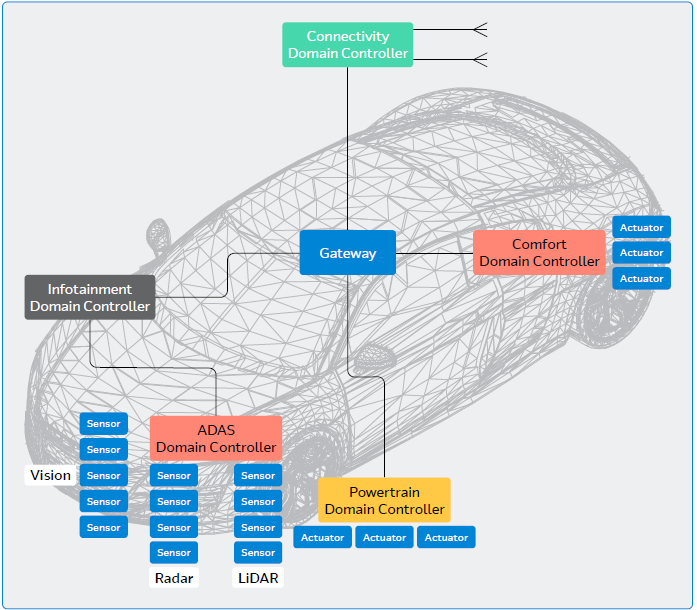
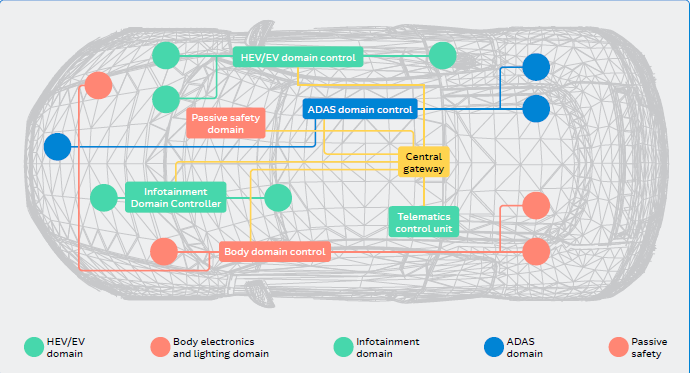
E/E Architecture: Engineering the New Vehicle Nervous System
To support this transformation, Arrow Electronics has launched a strategic initiative and dedicated research hub focused on enabling robust next‑generation Electrical and Electronic (E/E) architectures. The initiative addresses critical design, integration, and supply‑chain requirements for OEM and tier‑1 engineering teams building the next wave of mobility platforms.
Arrow Electronics: Technical Enablement Across the Full E/E Stack
Cross Disciplinary Engineering Support: Arrow’s initiative provides engineering teams with access to expertise spanning semiconductors, networking, IP&E, system architecture, safety, and cybersecurity. This includes:
- Architecture level guidance on HPC, zonal, and endpoint implementation
- Safety and cybersecurity engineering aligned to ISO 26262, ISO 21434, and UN R155 expectations
- Power distribution and 48V readiness design considerations
- EMC-driven component selection for high-speed Ethernet and mixed signal environments
This interdisciplinary support helps design teams reduce risk early in platform development.
“E/E architecture is the cornerstone of the modern automotive revolution, enabling the transition from hardware-centric machines to intelligent, software-defined mobility,” said Murdoch Fitzgerald, chief growth officer of global services for Arrow’s global components business. “By combining our global engineering reach with a broad range of components and specialized software expertise, we are well positioned to help our customers navigate this complexity, reducing their time-to-market and helping ensure their platforms are built to adapt as the industry evolves.”
Comprehensive Technology Ecosystem
Arrow’s portfolio includes components and subsystems essential to modern architectures, such as:
- Vehicle networking processors and real-time controllers
- PCIe switching and high-speed interconnect devices
- Automotive Ethernet PHYs, switches, MACsec enabled devices
- High-speed connectors and automotive-grade cabling ecosystems
- Automotive memory, storage, timing, and power components
Access to these technologies simplifies system integration and allows rapid architecture prototyping.
Strengthened Software & Safety Capabilities: Through expanded software engineering centers and the addition of established automotive software firms, Arrow now supports:
- AUTOSAR Classic and Adaptive development
- System-level modelling, HIL/SIL workflows, and model-based development
- OTA and diagnostic pipeline development
- Functional safety engineering and cybersecurity analysis
These capabilities enable engineering teams to build systems that are robust, certifiable, and scalable across vehicle lines.
Automotive Grade Supply Chain Reliability: Modern vehicle platforms require stable, long lifecycle, traceable electronic components. Arrow supports engineers with:
- Multi-sourced, risk-balanced component strategies
- Lifecycle and obsolescence planning
- Global inventory breadth across semiconductor and IP&E categories
This mitigates supply chain risk during development, validation, and production scaling.
Arrow’s E/E Architecture Research Hub
To accelerate architecture development, Arrow has launched an external research hub providing:
- Technical whitepapers
- High-level and subsystem-specific design guidance
- Deep dive analyses of HPC, zonal, and endpoint architectures
- Reference material on safety, cybersecurity, and diagnostics
- Component selection insights and technology mappings
The hub is designed as a resource for engineers, architects, and procurement specialists engaged in next-generation platform design.


Photo copyright 2026 Artlist Ltd.
Local customer success case:
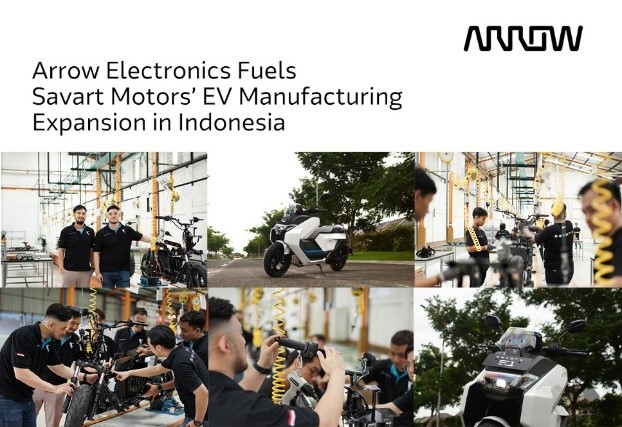
Arrow Electronics Fuels SAVART Motors’ EV Manufacturing Expansion in Indonesia, Boosting engineering and supply chain capabilities to drive sustainable e-mobility
Arrow has supported Indonesia’s homegrown EV maker SAVART Motors in designing and manufacturing high-quality, safe, and affordable electric scooters.
Founded in 2018, SAVART Motors stands out as one of the few local brands with in-house R&D capabilities, advanced prototyping hardware and software, and a dedicated testing and manufacturing facility in Mojokerto, East Java, Indonesia.
Indonesia’s motorcycle market is the third largest in the world. With nearly 130 million motorcycles on the road, the emissions from these vehicles significantly impact air quality and contribute to climate change. To address this, Indonesia aims to have 13 million electric two-wheelers on the roads by 20302, reducing greenhouse gas emissions and air pollution while promoting eco-friendly commuting.
Empowering homegrown EV entrepreneurs to drive electrification and e-mobility, SAVART Motors meticulously designs its electric scooters from the ground up, seamlessly integrating design aesthetics and performance to suit road conditions, riding culture, and local market expectations. With a strong commitment to quality, safety, comfort, and R&D excellence, the majority of electrical and mechanical components are developed in-house by a team of dedicated and talented engineers who are graduates of leading universities in Indonesia.
SAVART Motors is electrifying Indonesia’s transportation landscape by designing and manufacturing its electric vehicles almost entirely in-house. The company has reached a significant milestone with a 74.27% TKDN verification, reflecting the high level of domestic content in its goods and services produced in Indonesia. From concept through production, SAVART’s engineers develop cutting-edge technology tailored to the needs of local riders. Through its collaboration with Arrow Electronics, SAVART gains access to advanced components from leading global brands such as Analog Devices, Infineon, Littelfuse, Quectel, and STMicroelectronics. Arrow’s support strengthens SAVART’s designs, accelerates production timelines, and enables efficient scaling, while helping the company maintain its commitment to quality and innovation as a homegrown Indonesian brand.
“Electrification and AI-powered technologies are fundamentally transforming transportation,” said Dr. Raphael Salmi, president of Arrow Electronics’ South Asia, Korea & Japan components business. “We are excited to provide SAVART Motors with the essential engineering capabilities and supply chain services they need to manufacture EVs that not only prioritize safety, comfort, and ease of use but also cater to the needs of Indonesian riders. By offering a comprehensive technology portfolio that includes smart IoT connectivity modules, microprocessors, sensors, and automotive-grade silicon carbide MOSFETs, we are well-positioned to be their trusted technology supplier as they continue to revolutionize sustainable e-mobility in Indonesia and beyond.”
A substantial portion of the electronic components in SAVART Motors’ latest model has been sourced and supplied by Arrow. In addition to complementing SAVART Motors’ in-house R&D efforts, Arrow has provided engineering support and guidance on system integration, including adaptive user interfaces, smart vehicle control units, AI-based user profiling, keyless and fingerprint security access, and smart battery management systems.