

Governments have increased their efforts to improve safety standards and environmental conditions, leading to increased adoption of HMI systems.
The global automotive human machine interface (HMI) market is expected to grow at a CAGR of close to 8% during the period of 2016 to 2020, according to analysts at Technavio.




HMI is a vital component for enabling rich infotainment features in addition to safety features in the vehicles. Hence, they are mostly preferred by the vehicles for long distance traveling. The HMI provides voice notifications, alerts and visuals for functions like the Internet, GPS navigation and information. The HMI provides these added benefits to the vehicles, where the HMI systems facilitate long distance travel.
HMI systems are widely adopted in America and Europe, where touring vehicle penetration is high. APAC, meanwhile, is dominated by the traditional low segment vehicles due to the preference for vehicles required for daily commuting, instead of long distance traveling. In addition, HMI has high penetration in high-end vehicles, which constitutes lower percentage in APAC.
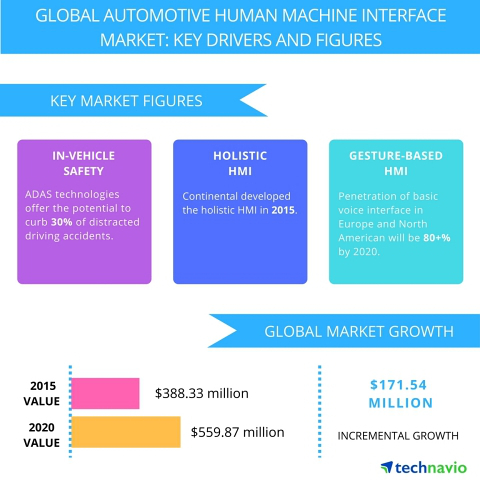
Technavio automotive analysts say there are three factors that are contributing to the growth of the global automotive HMI market:
High co-relation generating economies of scale
The economies of scale play an important role in today’s market. It is needed to leverage the use of technology to maximum customers. For instance, adoption of smartphones across the world increased significantly in last four to five years owing to the reduced price. This price reduction was fuelled by the advantage of economies of scale to smartphone manufacturers due to increased production.
“Hardware cost remains a primary consideration for OEMs, and by keeping a close eye on consumer electronics the OEMs are able to adopt new technology in cost effective way. Additionally, when any technology is adopted in consumer electronics, its volume grows, and that drives the prices down in the market, which accounts for the benefits of the automotive market,” said Siddharth Jaiswal, a lead automotive electronics analyst at Technavio.
Smartphone integration with vehicles boosting demand for HMI
The evolution of the trend of connectivity in vehicles has resulted in consumers connecting their smartphones and tablets to the vehicles’ infotainment systems. For instance, Apple’s car integration Carplay and Android Auto are used widely by automotive OEMs in their infotainment systems to allow drivers to connect their smartphones to the car.
“Hyundai Blue Link infotainment systems mirror a smartphone on a vehicle’s display screen through an interface or Bluetooth. Also, GM empowered its MyLink and IntelliLink infotainment systems to support applications developed by third parties,” added Siddharth.
Government intervention to increase in-vehicle safety will push demand for HMI system
Governments worldwide have increased their efforts to improve safety standards and environmental conditions. Hence, telematics services such as e-call and emergency road assistance-global navigation satellite system (ERA-GLONASS) are increasingly being adopted, which, in turn, is leading to increased adoption of HMI systems. Government agencies are increasingly placing more focus on preventing distracted driving, so regulation of the automotive industry and its output has increased.
The focus towards the adoption of safety technologies like advanced driver assistance systems (ADAS) is also another factor contributing to the adoption of HMI. For instance, ADAS technologies offer the potential to curb 30% of all these accidents while autonomous technologies can curb by 90%. While ADAS contribute to the curbing of accidents, the ability of the automotive reconfigurable instrument cluster that is likely to assist the driver with easier information processing of in-vehicle systems.

