
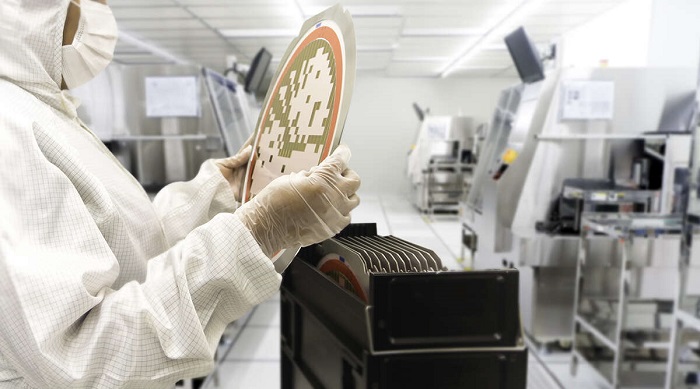
COVID has affected many industries, and the semiconductor industry is no different. Due to the highly complex and technical – and not to mention secretive – nature of the chips themselves, it takes a highly specialized manufacturing setup to make a specific design. So, when COVID-19 caused semiconductor factories to close, it didn’t take long for a supply problem to emerge.
The two main markets for semiconductors are automotive and consumer electronics. A standard car with a traditional combustion engine uses about 1,300 chips and there are three times as many in an electric vehicle. In consumer electronics, chips are found everywhere –– in mobile phones, laptops, games consoles and smart watches. In the pandemic-restricted situation of 2020, with over half of the world’s population in full or partial lockdown, the usual balance of demand for these two markets changed. Automotive sales declined, whereas sales of consumer electronics soared as a stuck-at-home population relied on electronic gadgets to keep them occupied.




This means that the semiconductor chips that were being produced were being snapped up by consumer electronics. This wasn’t so much of an issue while the automotive market was depressed, but what about now, when markets are making a comeback?
A shaky post-COVID recovery
While at the time of writing, COVID hasn’t completely disappeared, vaccine programs and local containment measures are helping many industries get back to something like normality. The automotive sector is certainly poised to ramp up production to meet consumer demand as people start to think about travelling again. However, the semiconductor chips that are essential in every vehicle are not readily available and many auto manufacturers have had to halt production already to wait until those components can be produced.
Chip manufacturers are also getting back into the swing of manufacturing and ramping up to pre-2020 levels, but progress is understandably slow. Chips are complex and made in cleanroom environments that usually operate round the clock. Starting production after a shutdown is not as simple as flipping a switch. And manufacturers will be keen to ensure that the chips produced are of the same quality as before the extended shut-down. And it’s in high-volume quality control that the right analysis technology can help manufacturers get back to full scale production.
FT160 for meticulous quality control of electronic devices
From verifying components while in the wafer stage to checking the integrity of contacts in the finished device, semiconductor manufacturers will need to check the quality of every stage of the process as they ramp up production. And here’s where the FT160 XRF benchtop analyzer from Hitachi High-Tech can help.
The FT160 has been designed specifically to measure coating thicknesses on electronics devices. Ideal for high-throughput quality analysis of wafers, PCB and connectors, the FT160 is large enough to accommodate components up to 600mm by 600mm in size. It contains automated controller software and a high-resolution optical camera to help find and isolate the specific features you need to measure. But perhaps the most impressive feature of the FT160 is its polycapillary optics system. The instrument generates a high-intensity 30 µm X-ray beam that can measure features of less than 50 µm. This, coupled with a high sensitivity X-ray detector, means you can measure coatings fast, with no loss of accuracy.
The FT160 is a powerful tool to ensure component quality as you ramp up production. And, as auto manufacturers are rumored to be using the lull in supply to make design improvements to their ranges, it can also help in ensuring production processes are optimized for new devices. For when you need to check quality at every stage, the FT160 gives you precise results fast.
For more information please visit: https://hha.hitachi-hightech.com/en/

