HomeIndustryAerospace and DefenceISRO's Algorithm to Clear Out Haze from Earth Observation Satellites Captured Images

    ISRO’s Algorithm to Clear Out Haze from Earth Observation Satellites Captured Images

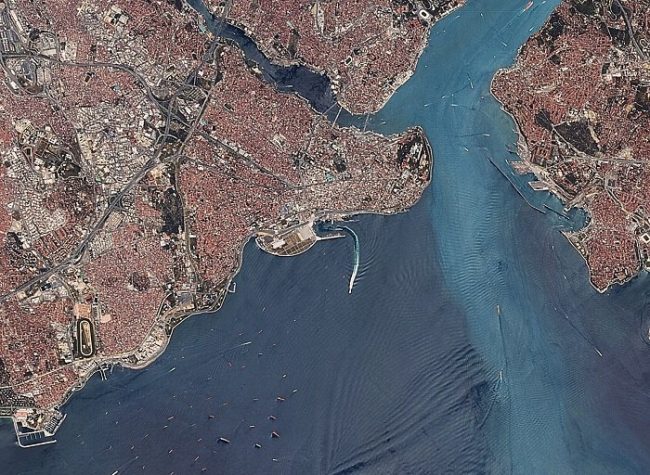
    One of the many facilities of ISRO across the country, the Space Applications Centre in Ahmedabad has come up with an algorithm that clears the haze from images captured by Earth observation satellites such as the CartoSat series of satellites.

    Existing approaches require simultaneous processing information from visible and short-wave infrared channels simultaneously, which was not possible with the visible and near-infrared range sensors used in the CartoSat series of satellites. The approach by ISRO uses the data captured by the visible and near-infrared range sensors and compares it to available datasets of the optical properties of aerosols, the particles that cause the haze. This information is used to remove the haze from images, providing clear images.


    ISRO explains the process as, “The algorithm uses lookup tables generated with vector radiative transfer calculations. Derived aerosol information and pre-computed lookup tables are employed to derive surface reflectance.  Good quality surface reflectances have been obtained when this algorithm was applied on Cartosat-2 Series Satellite data.”

    The CartoSat series of satellites provide multi-spectral images in the visible and near-infrared range, with a resolution of a few meters to even sub-meter resolution images. The satellites allow the country to monitor changes on the surface of the Earth. The last CartoSat placed into orbit was a CartoSat 2 series satellite, one of the 31 satellites on board the PSLV-C38 mission launched on 23 June.

    The next launch by ISRO is scheduled on 31 August, where a PSLV will place into orbit the IRNSS-1H, a replacement satellite for a malfunctioning one in the Indian NavIC constellation for navigational purposes.

    ELE Times Bureau
    ELE Times Bureauhttps://www.eletimes.ai/
    ELE Times provides a comprehensive global coverage of Electronics, Technology and the Market. In addition to providing in depth articles, ELE Times attracts the industry’s largest, qualified and highly engaged audiences, who appreciate our timely, relevant content and popular formats. ELE Times helps you build awareness, drive traffic, communicate your offerings to right audience, generate leads and sell your products better.

    Related News

    Must Read

    Top Seven Tech Trends in the semiconductor sector for 2026

    In 2026, a new class of intelligent machines will...

    Keysight launches next-gen Infiniium XR8 Oscilloscopes for faster analysis, clearer insights, and a compact design

     Keysight Technologies introduced its next-generation Infiniium XR8 Real-Time oscilloscopes,...

    R&S showcases its comprehensive embedded systems test solutions at embedded world 2026

    Rohde & Schwarz will present its advanced test and...

    Toxics Link study Finds a Long Road to Circularity in India’s E-waste EPR Model

    A new report by an environmental group, Toxics Link,...

    ESGDS’ AI platform slashes data processing time by 98% with MongoDB Atlas

    ESG Data & Solutions (ESGDS) is a fast-growing Indian...

    Keysight Unveils 3D Interconnect Designer for Chiplet and 3DIC Advanced Package Designs

     Keysight Technologies introduced 3D Interconnect Designer, a new addition to...

    Jodi Shelton, CEO of GSA – Launches A Bit Personal, a New Podcast Offering Rare, Candid Conversations with the Most Powerful Tech Leaders

    Jodi Shelton, Co-Founder and CEO of the Global Semiconductor Alliance and Shelton...

    Is SDV Really an Automotive or Just A Software-based machine That Moves?

    Speaking at the Auto EV Tech Vision Summit 2025,...

    ROHM’s New Compact, Highly Reliable Package Added to Automotive 40V/60V MOSFET Lineup

    ROHM has expanded its lineup of low-voltage (40V/60V) MOSFETs...