
“Hey, Siri, how’s the weather today?” Voice recognition technology is increasingly prevalent. It is a convenient technology with broad applications. However, to get the most of its intended functions, users must stand near the device and articulate carefully. What if the skin on our bodies could recognize voices without the use of devices?
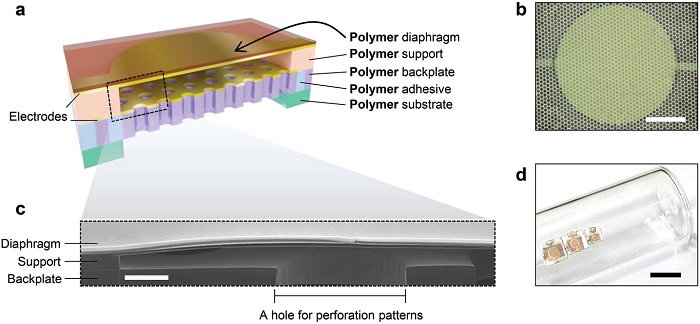
Professor Kilwon Cho and Dr. Siyoung Lee of the Department of Chemical Engineering, together with Professor Wonkyu Moon and Dr. Junsoo Kim of the Department of Mechanical Engineering at POSTECH have developed a microphone that detects sound by applying polymer materials to microelectro-mechanical systems (MEMS)




The small, thin microphone demonstrates a wider auditory field than human ears, while it can be easily attachable to the skin.
The conventional MEMS-based microphones used in cellular phones, Bluetooth devices, and others consist of thin, small, and sophisticated diaphragm structures. As they are made of rigid, brittle silicon, however, it is difficult to bend the diaphragm or microphone as desired, which interferes with the sound detection ability of the device.
The research team overcame this limitation by creating a MEMS-based microphone structure by using polymer materials that are more flexible than silicon and can be designed in any shape. The size of the device is a quarter of a fingernail and its thickness is only a few hundred micrometers (μm, 1μm=one-millionth meter). The microphone can be attached to large surface areas of the body or even on the finger.
According to the study, the auditory sensitivity of the microphone is higher than human ears, while recognizing the surrounding sounds and voice of the user without distortion. Furthermore, it can detect both loud sounds over 85 decibels, a range that causes auditory damage, and low-frequency sounds that humans cannot hear.
The quality of voice detection is comparable to cellular phones or studio microphones. When the acoustic sensor on the skin was connected to a commercial voice assistant program (Google Assistant), the user could search, translate and control devices effortlessly.
The new acoustic sensor has potential applications in wearable voice recognition devices for the Internet of Things (IoT) and human-machine interfaces. The research team plans to create auditory electronic skin by integrating it with skin-attachable pressure and temperature sensors, flexible displays, and others.

