

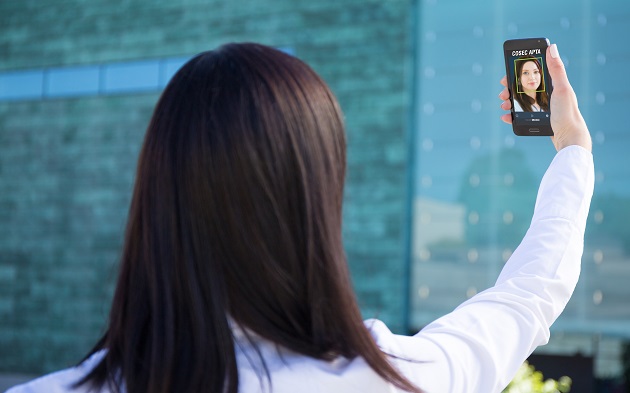
Matrix, a world class manufacturer of Telecom and Security solutions, recently unveiled its indigenously designed COSEC Facial Recognition. Matrix COSEC Face Recognition is based on innovative, deep learning technology, which evolves as per regular user interaction in different conditions. It identifies a user quickly and accurately with 1:1 or 1:N identification method. The technology checks liveness of a face with 99.53% accuracy. It accepts the user’s mobile as a credential, which eliminates hardware cost and makes the verification process simple and secure.
With contactless authentication, Matrix COSEC Facial Recognition technology reads the user’s face through COSEC APTA application. It ensures contactless authentication and identifies user’s face in <1 Sec. It eradicates the issues of identifying varying height of user(s) as the user needs to capture the image of their face in a smart phone for authentication process. Moreover, it works well even in low bandwidth conditions and is agnostic to changes in facial hair, angles and lighting.



“Matrix Facial Recognition is a powerful tool conceived with Liveness Detection method. It has the ability to read beyond the surface of the skin and identifies real skin within fraction of a second. With the addition of these unique biometric technology in our range of security solutions, we want to weave our image as a company manufacturing solutions catering to different verticals for various Access Control and Time-Attendance applications”, commented Jatin Desai – Product Manager, Access Control and Time-Attendance.
Smartphone as an Identity: By installing COSEC APTA application in their smartphone, users’ mobile becomes a biometric device for Time-Attendance and Access Control applications. Identification or verification is done through capturing an image of their face through the phone’s camera which in turn marks their attendance.
Ease of Face Enrollment: The user face enrollment is done by capturing the image of a user’s face from different angles, which gets stored in COSEC CENTRA/VYOM database.
Unique Enrollment: Due to unique technology of TRAIN feature in COSEC APTA, user’s face can get easily recognized in dynamic and uncontrolled environments. With TRAIN feature, user can add many images of their face for error free facial recognition.
Face Recognition: It works on 1:N authentication method wherein, a user’s face is compared with the facial images in a database of stored records.
Face Detection: It works on 1:1 authentication method wherein, a user’s face is verified against the logged in ID of the user.
Dual Security: For strong authentication, user’s face is verified after establishing Bluetooth connectivity with the assigned door for accessing the door assigned to respective user.
Location Tracking through GPS: To keep track of the user’s movement outside/inside the premises, COSEC APTA sends location details to the server using GPS by taking user’s face image from the present location.

