
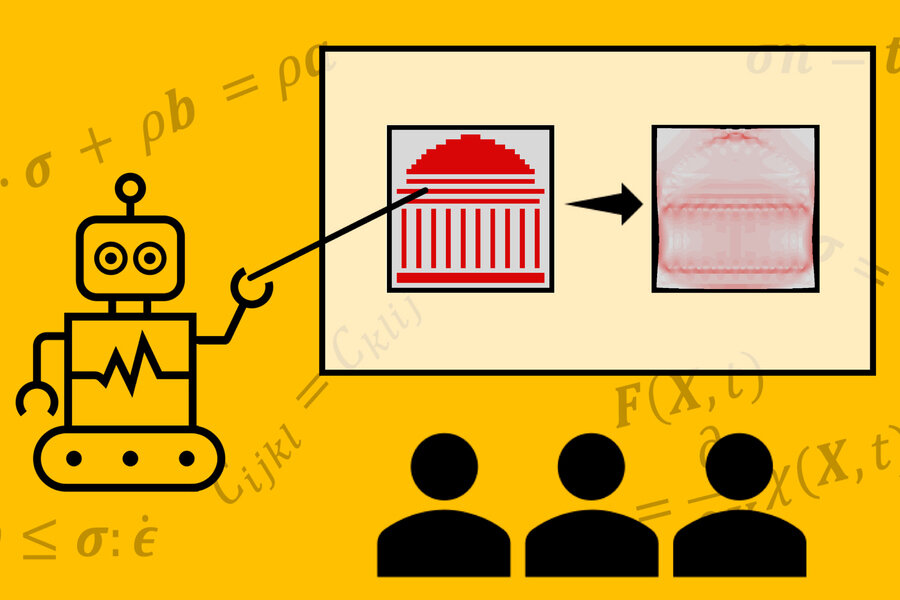
MIT researchers have developed a technique to quickly determine certain properties of a material, like stress and strain, based on an image of the material showing its internal structure. The approach could one day eliminate the need for arduous physics-based calculations, instead of relying on computer vision and machine learning to generate estimates in real-time.
The researchers say the advance could enable faster design prototyping and material inspections. It’s a brand new approach, the algorithm completes the whole process without any domain knowledge of physics.




Engineers spend lots of time-solving equations. They help reveal a material’s internal forces, like stress and strain, which can cause that material to deform or break. Such calculations might suggest how a proposed bridge would hold up amid heavy traffic loads or high winds. Unlike Sir Isaac, engineers today don’t need pen and paper for the task. Many generations of mathematicians and engineers have written down these equations and then figured out how to solve them on computers. But it’s still a tough problem. It’s very expensive—it can take days, weeks, or even months to run some simulations. So, we thought: Let’s teach an AI to do this problem for you.
The researchers turned to a machine learning technique called a Generative Adversarial Neural Network. They trained the network with thousands of paired images—one depicting a material’s internal microstructure subject to mechanical forces, and the other depicting that same material’s color-coded stress and strain values. With these examples, the network uses principles of game theory to iteratively figure out the relationships between the geometry of a material and its resulting stresses.
So, from a picture, the computer is able to predict all those forces: the deformations, the stresses, and so forth. That’s really the breakthrough—in a conventional way, you would need to code the equations and ask the computer to solve partial differential equations. We just go picture to picture.
That image-based approach is especially advantageous for complex, composite materials. Forces on a material may operate differently at the atomic scale than at the macroscopic scale. If you look at an airplane, you might have glue, a metal, and a polymer in between. So, you have all these different faces and different scales that determine the solution. If you go the hard way—the Newton way—you have to walk a huge detour to get to the answer.
But the researcher’s network is adept at dealing with multiple scales. It processes information through a series of “convolutions,” which analyze the images at progressively larger scales. That’s why these neural networks are a great fit for describing material properties.
The fully trained network performed well in tests, successfully rendering stress and strain values given a series of close-up images of the microstructure of various soft composite materials. The network was even able to capture “singularities,” like cracks developing in a material. In these instances, forces and fields change rapidly across tiny distances.
The advance could “significantly reduce the iterations needed to design products,” according to Suvranu De, a mechanical engineer at Rensselaer Polytechnic Institute who was not involved in the research. “The end-to-end approach proposed in this paper will have a significant impact on a variety of engineering applications—from composites used in the automotive and aircraft industries to natural and engineered biomaterials. It will also have significant applications in the realm of pure scientific inquiry, as force plays a critical role in a surprisingly wide range of applications from micro/nanoelectronics to the migration and differentiation of cells.”
In addition to saving engineers time and money, the new technique could give nonexperts access to state-of-the-art materials calculations. Architects or product designers, for example, could test the viability of their ideas before passing the project along to an engineering team.
Once trained, the network runs almost instantaneously on consumer-grade computer processors. That could enable mechanics and inspectors to diagnose potential problems with machinery simply by taking a picture.

