
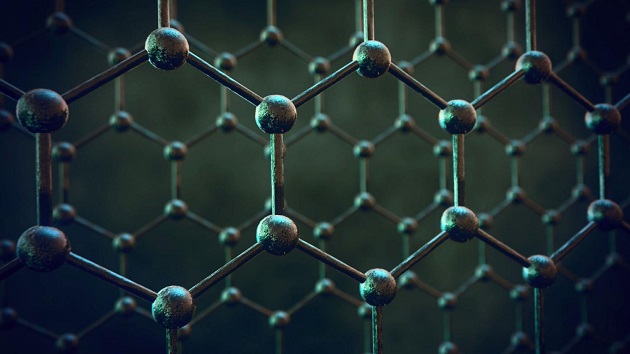
A new sensor design makes use of the optoelectronic properties of graphene to enable simultaneous detection of multiple substances, including bacteria and other pathogens. The design is based on 2D graphene sheets, each just one atom thick, and was created by researchers at China Jiliang University.
Using theoretical calculations and simulations, the researchers designed an array of nanoscale graphene disks. They introduced a small circular defect, an off-center hole, into each nanodisk. When light hit the disk array, the interaction between the disks and their holes created a plasmon hybridization effect, increasing the sensitivity of the device. The hole and the disk create different wavelength peaks, which can be used simultaneously to detect the presence of different substances.




The graphene disks were installed between an ion-gel layer and a silicon layer. These layers were used to apply voltage to the sensor, tuning the graphene’s properties for detection of various substances.
Simulations performed by the researchers using MIR wavelengths showed that their new sensor platform was more sensitive to substances present in gases, liquids, and solids than a sensor platform comprised of graphene disks alone, with no circular defects.
The researchers are now working to improve the process that will be used to make the array of nanoscale disks. According to the team, the degree of precision with which these structures are fabricated could greatly impact the performance of the sensor.
“We also want to explore whether the graphene plasmon hybridization effect could be used to aid the design of dual-band mid-infrared optical communication devices,” said researcher Bing-Gang Xiao.
Because of its desirable properties, graphene has been used by various research teams to create sensors and materials for a range of applications. However, the China Jiliang team said few previous research efforts have demonstrated sensitive graphene sensors that work with the IR wavelengths necessary to detect bacteria and biomolecules.
In addition to improving food safety, the new sensor design could be used to detect gases and chemicals for a wide range of applications. Its dual-band resonance structure feature could support the development of multisubstance detection.

