

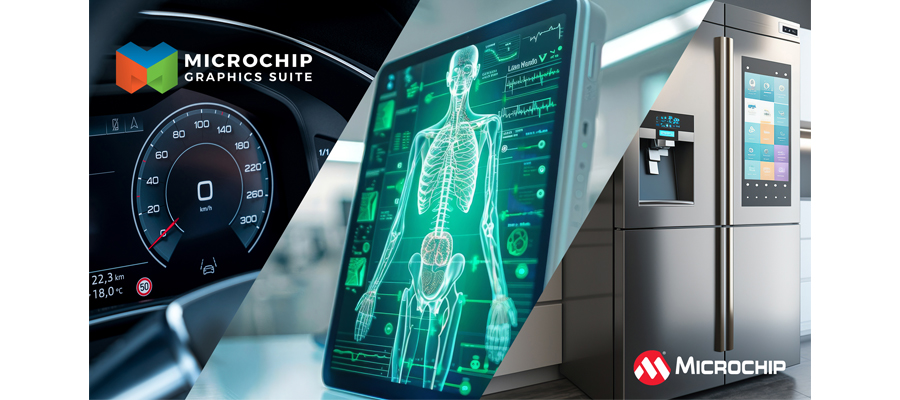
Microchip Graphics Suite is designed to enable seamless portability between Microchip product families and environments to help designers significantly reduce development costs and speed time to market
Designers are incorporating Graphical User Interfaces, or GUIs, into more electronic devices to enhance the user experience by providing intuitive and visually appealing interactions with today’s modern applications. To support embedded developers with their designs, Microchip Technology announces Microchip Graphics Suite (MGS), an easy-to-learn, comprehensive solution that simplifies the process of incorporating GUIs, animations and images into a touchscreen display.



Developing a GUI can be a complex and lengthy process, requiring significant time and resources to debug and integrate code from various tools. MGS is designed to easily integrate with Microchip’s 32-bit microcontrollers (MCUs) and microprocessors (MPUs) and supports multiple development platforms, including MPLAB Harmony v3 and Linux environments. This comprehensive solution to build a GUI interface aims to help designers improve reusability across projects and simplify design complexities.
MGS offers compositional tools, including a simulator for hardware-free prototyping. By leveraging the MPLAB Code Configurator (MCC), the simulator builds the MCC-generated C code in either web or native mode. In web mode, the tool creates an HTML file that can run on most web browsers with simulated touch interactivity. In native mode, the simulator enables debugging of the GUI on Windows desktop computers. These features enable accurate display and functionality demonstrations that are independent of hardware availability.
MGS provides an intuitive WYSIWYG interface with a modern design, enabling users to directly see and manipulate the final output, reducing errors and increasing efficiency. To make GUIs more accessible, MGS is versatile and can support a wide range of devices of varying performance. They can range from resource-constrained devices with significantly lower memory and system performance requirements to high-performance devices supporting tablet-sized touchscreens with high-fidelity video playback.
This solution is optimal for developers who want superior graphical performance without costly hardware upgrades. Additionally, MGS supports a wide range of displays, from monochrome OLEDs to 1080p 16.7M color TFTs, including MIPI DSI, LVDS, RGB, SPI, and HDMI interfaces, along with touchscreens with 2D/3D gestures.
“At Microchip, we are committed to providing our customers with comprehensive solutions and cutting-edge tools that empower them to make high-quality products and get to market faster,” said Rod Drake, corporate vice president of Microchip’s MCU32 and MPU32 business units. “This innovative tool suite simplifies the process of creating engaging and responsive displays for everything from smart home devices to industrial equipment.”
This comprehensive solution simplifies the integration of a GUI from design phase to implementation across a wide range of applications. MGS is highly compatible with the company’s broad portfolio of PIC32 MCUs, SAM MPUs and maXTouch touchscreen controllers. Additionally, Microchip can provide other key components including memory, power management and connectivity solutions.

