
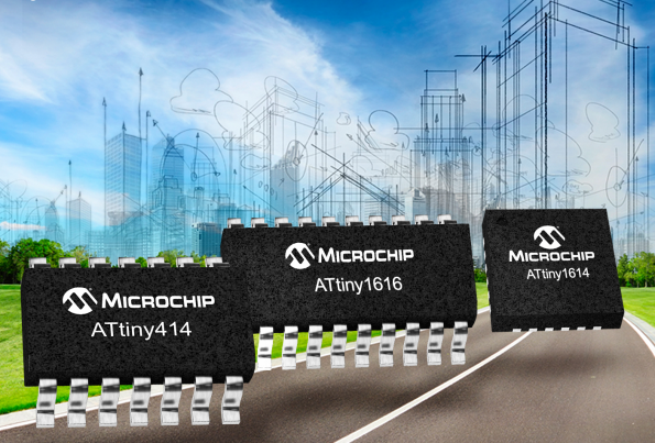
Microchip Technology Inc., a leading provider of microcontroller, mixed-signal, analog and Flash-IP solutions, has further expanded its AVR microcontroller (MCU) portfolio by adding three new devices to the tinyAVR MCU family. The new ATtiny1617 series of MCUs expand the range of AVR devices that feature Core Independent Peripherals (CIPs), which help increase system throughput and while lowering overall power consumption. The new devices extend the memory offering for these next generationtinyAVR MCUs with new 16KB Flash options, while remaining pin and code compatible with the recently released ATtiny817 series devices. Furthermore, all members of the family are supported by Atmel START, an online tool for intuitive graphical configuration of embedded software projects.
The new MCUs offer 16KB Flash, 256B EEPROM, and 2KB RAM in 14-, 20-, and 24-pin packages. The devices contain key features of other tinyAVR MCUs including the Event System Controller, which allows peripherals to communicate without using the Central Processing Unit (CPU) and enables designers to customise the configuration of the MCU for their specific application. The on-chip Peripheral Touch Controller (PTC) simplifies the development of capacitive touch systems. Other integrated features include: a 20 MHz internal oscillator, high-speed serial communication with USART, SPI, and I2C, configurable custom logic blocks, a 10-bit Analog-to-Digital Converter (ADC) with internal voltage references, operating voltages ranging from 1.8V to 5.5V, and pico Power technology for sleep currents as low as 100nA.




“There is more growth and innovation in the AVR MCU portfolio now than at any point in the past decade,” said Steve Drehobl, vice president of Microchip’s 8-bit MCU division. “Microchip is committed to continue the AVR MCU family of products.”
Development and support
The new devices are fully supported by the Atmel Studio 7 Integrated Development Environment (IDE), the STK600 platform and Atmel START, a free online tool to configure peripherals and software for easy development.
Availability
- The three new ATtiny MCUs are available for sampling and in volume production.
- ATtiny1617 is available in a QFN24 package for 10k units.
- The ATtiny1616 is available in a QFN20 and SOIC20 package for 10k units.
- The ATtiny1614 is available in a SOIC14 package for 10k units.
For more information, visit: www.microchip.com/1617series

