
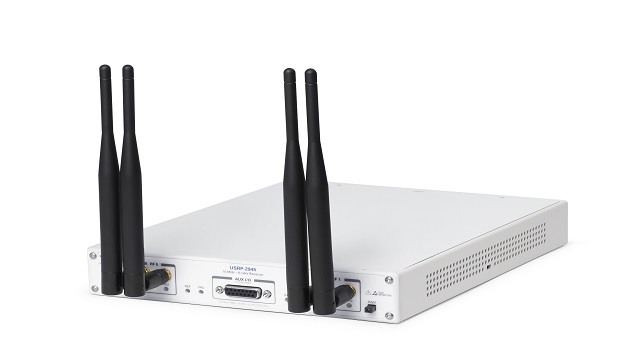
Introducing the latest additions to the most complete and scalable line of software defined radio (SDR) solutions available for aerospace, defense and wireless prototyping applications
NI, the provider of platform-based systems that enable engineers and scientists to solve the world’s greatest engineering challenges, on February 23, 2017, announced the availability of the USRP-2945 quad receiver SDR device and the USRP-2944 high-performance 2×2 multiple input, multiple output (MIMO) SDR device. Both models deliver a new level of performance and capability to the USRP (Universal Software Radio Peripheral) family. These devices feature the widest frequency ranges, highest bandwidth and best RF performance in the USRP family.




The USRP-2945 and USRP-2944 join the NI SDR portfolio of products, which scale from small deployable radios to 128-antenna massive MIMO systems. Engineers can use the extensive NI SDR product family to efficiently transition from design to prototyping and deployment across a wide range of wireless applications through a unified design flow. They can combine NI SDRs with LabVIEW software to rapidly develop real-time communication and wireless receiver systems, and prototype new algorithms with real-world signals through the onboard FPGA and FPGA programming tools. Additionally, engineers can efficiently incorporate NI SDR products with other NI hardware to design solutions that address the most demanding applications, benefitting from hardware flexibility combined with a unified software tool chain.
Specifically designed for over-the-air signal acquisition and analysis, the USRP-2945 features a two-stage superheterodyne architecture to achieve the superior selectivity and sensitivity required for applications such as spectrum analysis and monitoring, and signals intelligence. With four receiver channels, and the capability to share local oscillators, this device also sets new industry price/performance benchmarks for direction finding applications.
For wideband wireless research, the USRP-2944 is a 2×2 MIMO-capable SDR that features 160 MHz of bandwidth per channel. With a frequency range from 10 MHz to 6 GHz, this SDR works in frequencies of interest for LTE and WiFi research and exploration, covering potential new spectrum deployments.
“With the future of spectrum usage and management tied to spectrum sharing, it is imperative to have cost-effective tools to enable researchers, regulators and corporations to more effectively scan, capture and analyze the spectrum to create spectrum situational awareness and respond accordingly,” said Manuel Uhm, director of marketing for Ettus Research, a National Instruments company, and chair of the board of directors for the Wireless Innovation Forum. “NI offers the broadest portfolio of SDRs and has now added a multichannel wideband transceiver and superheterodyne receiver that deliver the superior RF performance required for high-performance spectrum research.”
Find more information on the USRP-2945 and USRP-2944 at www.ni.com/usrp-rio.

