
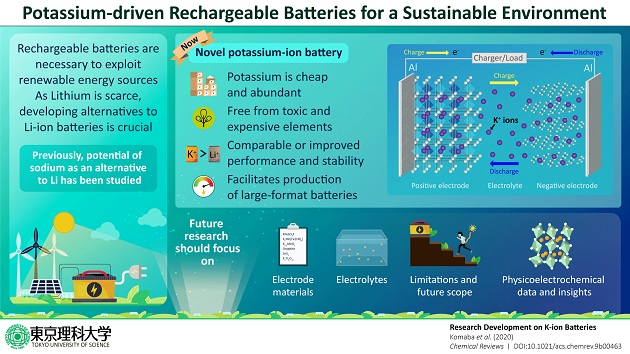
Our modern lifestyle would be immensely different without rechargeable batteries. Owing to their low-cost, recyclable technology, these batteries are used in most portable electronic devices, electric and hybrid vehicles, and renewable power generation systems. And why shouldn’t they be? They offer an elegant solution to the world’s growing energy demands. Moreover, rechargeable batteries are an essential tool in systems that harvest renewable energy, such as the wind and sunlight, because these sources can fluctuate greatly with the weather. Rechargeable batteries allow us to store the generated electricity and dispatch it on demand. Thus, it is no surprise that researchers globally have been focused on improving rechargeable batteries as a step towards developing sustainable energy resources.
Since their commercialization, lithium-ion batteries (LIBs) have been the go-to rechargeable batteries because of their excellent performance. However, with the ensuing spike in their demand, coupled with the limited availability of lithium and cobalt (another necessary element for LIBs) in Earth’s crust, using LIBs may soon become a major problem. This is why a team of scientists at Tokyo University of Science led by Prof Shinichi Komaba decided to walk the road less traveled: they focused on replacing the exhaustible element lithium with better alternatives like sodium and potassium. Sodium and potassium are in the same alkali metal group in the periodic table of elements, and their chemical natures are, therefore, quite similar. But, unlike lithium, these elements are widely abundant on Earth, and using them to develop high-performance rechargeable batteries would be a breakthrough towards creating a more sustainable society.




In 2014, Prof Komaba, along with Prof M. Stanley Whittingham, who won the Nobel Prize in Chemistry in 2019, analyzed the current state of development of sodium-ion batteries and published his assessments as a review. This became a highly cited study, with over 2,000 citations only in the past 5 years. Prof Komaba and his team then explored other plausible alternative to LIBs, potassium-ion batteries (KIBs), which have slowly become the focus of extensive research since 2015 after certain pioneering studies (e.g., a study published in Nature Materials in 2012), some of which were carried out by Komaba’s group. The use of potassium in batteries is promising because they show comparable (or even better) performance to LIBs. What’s more, the materials necessary to build KIBs are all non-toxic and much more abundant than those required for LIBs. Prof Komaba states, “By studying new materials for applications in lithium-, sodium-, potassium-ion batteries, we wanted to develop an energy-efficient and environment-friendly technology.”
In a remarkable effort to facilitate further research on KIBs, the research group led by Prof Komaba analyzed the workings of KIBs in great detail in a comprehensive review published in Chemical Reviews. Their paper encompasses everything related to the development of KIBs, from cathode and anode materials, various electrolytes and all-solid KIBs, to electrode doping and electrolyte additives. Moreover, the review compares the different materials used in lithium-, sodium-, and potassium-ion batteries. Being the only study that comprehensively analyzes several aspects of rechargeable batteries, it could prove really useful for leading current and future researchers in the right direction. Having comprehensive volumes of past research on KIBs and all the acquired insight condensed onto a single article is of immense value to anyone interested in delving in this research topic.
The continuous development of KIBs will hopefully bring about a rise in the use of this coveted alternative to LIBs. “As evidenced by recent intensive research, KIBs are recognized as promising next-generation battery candidates owing to their unique characteristics, such as cost-effectiveness, high voltage, and high-power operation. Further improvements to the performance of KIBs would pave the way for their practical application,” explains Prof Komaba.
However, research on certain aspects of KIBs, such as their safety, has been limited, and focus should be placed on obtaining more insight into what’s going on physically and chemically between the different components and elements. Prof Komaba is hopeful in this regard and concludes by saying, “Research on KIBs, including electrode materials, non-aqueous/solid electrolytes, and additives will provide new insights into the electrode reactions and solid ionics, opening up new strategies that would allow for the creation of next-generation batteries.” His research group has also focused on supercapacitors and biofuel cells along with both LIBs and sodium-ion batteries, which could all find very important functions in a more sustainable society in the future.

