
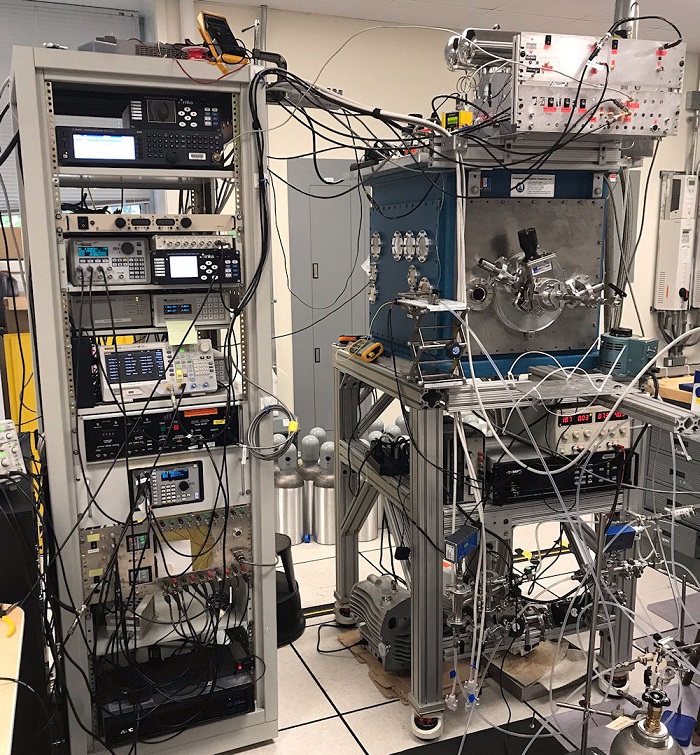
Microwave spectroscopy is a very powerful tool for discovering molecular structures and operates at very low temperatures near absolute zero (1 to 5 Kelvin). The spectrometers generally either operate with high sensitivity over a very narrow bandwidth or a wide frequency with reduced sensitivity. Researchers at the Harvard Smithsonian Center for Astrophysics have used a Spectrum Instrumentation digitizer card to create a next-generation molecular spectrometer with both high resolution and high sensitivity that is capable of capturing sample data substantially faster.
Brandon Carroll, a Post Doctoral Fellow on the project, explained, “The new design for cooling the sample chamber enables us to have a sampling rate much greater than the usual design, and do so over a wide bandwidth. We therefore needed a means to rapidly capture a large amount of data over a wide bandwidth. Some colleagues at the University of California in Davis recommended a Spectrum Instrumentation digitizer card. We chose an M4i.2230-x8 card as it has a huge amount of on-board memory, a bandwidth up to 1.2 GHz, and the ability to average extremely quickly. We looked at cards from other companies but they were more expensive or did not meet our specifications, as well as the Spectrum card, did. Plus, it was really easy to integrate with our software to fully automate the data acquisition process unlike the others we considered.”




Microwave spectroscopy is used to detect molecules’ shape and structure, and this gives unique information about the changes that occur during chemical reactions. “Until we built this spectrometer, it required very complex instruments to use microwave spectroscopy to investigate chemical reactions,” Brandon added. “Now we are able to investigate the detailed reaction dynamics of intermediary steps to see how it actually happens. The processes that dominate chemistry and physics change from those of higher temperatures when you are close to absolute zero, i.e., the temperature in many parts of space, hence this research by the Smithsonian Astrophysical Observatory.”
This new spectrometer will provide insights into the chemistry of the interstellar medium, i.e., what is in the space between planets and stars. That material is the feedstock for new solar systems and has a profound effect on how planets are formed – and even the origins of life.
He concluded, “The insights we obtain from this new design will give us a much greater understanding of interstellar chemistry, and we are finding that complex mixture analysis at ultra-cold temperatures is an exciting new direction for our us.”

