
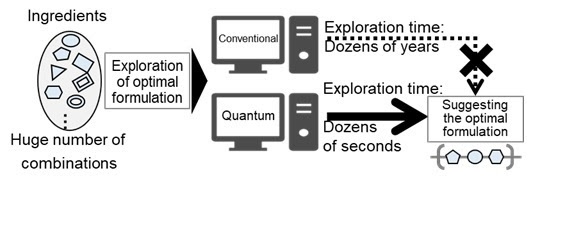
Showa Denko K.K. has demonstrated the ability of quantum computing technology to accelerate the exploration of the optimal formulation of semiconductor materials, reducing the exploration time from dozens of years of conventional methods to dozens of seconds.
Semiconductor materials contain numerous ingredients such as resins, fillers, and additives in various mixing ratios, and high-performance materials are obtained by optimizing the formulation. However, the theoretical number of combinations of ingredients and mixing ratios to be analyzed is more than 1050. Thus, it will take more than dozens of years to explore all possible combinations of these ingredients and their mixing ratios with conventional artificial intelligence (AI) methods. Therefore, we had analyzed only part of theoretically possible combinations before.




To reduce the time required for the exploration, we focus on using high-performance computing technology, Digital Annealer, a quantum-inspired technology developed by Fujitsu Ltd. Showa Denko has developed an AI model for predicting the properties of semiconductor materials from complex formulation conditions. To make the AI model computable on Digital Annealer, Showa Denko has expressed the AI model as an Ising model, one of the statistical mechanical methods. By simulating the Ising model on Digital Annealer, we have reduced the exploration time to dozens of seconds, about 72,000 times faster than the time required by conventional AI methods, where the type and amount of ingredients to be explored are limited for conventional AI methods. Moreover, the optimal formulation designed with the Ising model is expected to obtain semiconductor materials with 30% higher performance than the formulation designed with conventional AI methods.
In its “Long-term Vision for Newly Integrated Company,” the Showa Denko Group has announced that it will commit itself to research and development of AI and computational science, which is the core of its fundamental R&D activities. The result of this development is an example of achievements of R&D activities based on the application of “Chemistry to Think” on “Chemistry to Formulate,” both of which the Group has defined its basic frameworks for technological development. The Group will apply this development to various materials, accelerate our development activities, and provide our customers with solutions for their problems, thereby contributing to a sustainable society.

