
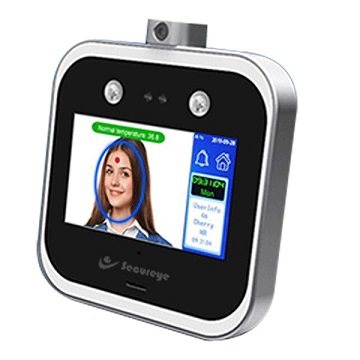
In a bid to promote a secure verification routine, Secureye has launched Temperature Detection & Face Recognition machine in India. Secureye, a leading brand of security products with a history of 25 glorious years, has always been at the forefront of developing valuable products. With the global pandemic affecting people across the world, the demand for “contactless” systems have risen. To enable corporate houses with contactless attendance of employees along with thermal(fever) detection, Secureye has stepped up to offer this new device.
The notable features of Temperature Detection & Face Recognition machine are Temperature Detection, Abnormal Temperature Automatic Alarm, Wearing Mask Identification, Abnormal Temperature Warning and Binocular Live Detection. The minimum unit from temperature detection is 0.1o C. In case of any anomalies in the body temperature, the device flashes a warning sign and also blows an alarm to alert the concerned authorities. As the fear of COVID-19 is expected to haunt us for months, this feature will help offices stay alert since abnormal body temperature is a significant indication of the virus.




Mr. Manish Agarwal, Director, Secureye said “Safety and security become utmost important during the times of crisis. With technology capabilities, it is possible to ensure a secure environment at workplace and Secureye’s new Temperature Detection & Face Recognition machine is an ace device for this purpose. We are always looking at the new developments to offer devices that can solve the real problems at the ground level, and hence we have launched Temperature Detection & Face Recognition machine.”
The device supports 200W Pixel HD colour camera, 100W infrared cameras and can perform body temperature detection from up to 0.5 meters. It has a display screen of 12.7CM electronic capacity touch screen with a screen resolution of 854 x 480. For knowledge transfer or communication, the device relies on TCP/IP, WiFi, USB Pen Drive. The device comes with an in-built rechargeable lithium battery with a USB port. It works on LINUX OS and it has the storage capacity 3000 user IDs, 20,000 face IDs, 1,000,000 user record. The device comes with dynamic facial recognition feature takes less than 2 seconds to complete verification. It also supports Door sensors function, U disk Port, Wiegand 26/34 input port and Wiegand WG26/34 Output. The product is priced at Rs.100000 + taxes

