
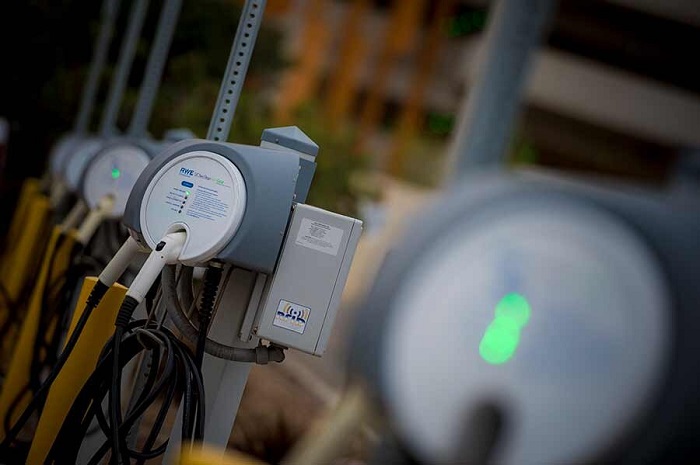
A team of engineers recommends expanding fast-charging stations for electric vehicles as campuses and businesses start planning for a post-pandemic world.
The recommendation is based on a study of charging patterns for electric vehicles on the University of California San Diego campus from early January to late May of 2020 after the university moved most of its operations online. Researchers say the findings can be applied to a broader range of settings.




“Workplace charging is a critical enabler of carbon-free transportation as the electrons consumed primarily come from solar power plants, as opposed to at-home charging, which occurs at night and relies more on fossil fuel power plants.
It’s the first time that a research team gathered information on workplace charging patterns for electric vehicles during the COVID-19 pandemic. As expected, charging declined dramatically once most campus operations became remote. Also as expected, charging at the campus’ medical center was less impacted as medical facilities continued most in-person operations, and healthcare workers and patients kept using those charging stations.
This reflects nationwide trends. Vehicle travel in the United States declined by about 40 percent from mid-March to mid-April 2020, according to the National Bureau of Economic Research.
But DC fast chargers that provide a full charge in about half an hour were less affected than what is known as Level 2 chargers, which provide a full charge over eight hours. Energy dispatched at Level 2 chargers on the main UC San Diego campus decreased by 84 percent. DC fast charging initially dropped by 67 percent. These stations quickly returned to near-normal usage in a short period of time, unlike Level 2 charging stations.
This finding reinforces ongoing efforts to deploy at least an additional 20 DCFCs primarily on the perimeter of campus in order to serve both UC San Diego commuters as well as the general public in need of recharging.
Only four out of 100 stations in the study were fast-charging. More broadly, in the United States, only a tiny fraction of charging stations are fast-charging, and most of those only serve Tesla vehicles. For example, California has about 31,800 EV charging stations. Of those, almost 3000 are Tesla supercharging stations, only available to Tesla vehicles. An additional 470 are DCFC stations managed by California-based Chargepoint.
The study looked at 100 charging stations in 28 parking structures. Specifically, researchers found that from March 11 to May 20, 2020:
- Charging on the main campus dropped by 84 percent from pre-pandemic levels
- Charging dropped by 50 percent at the parking structures at the UC San Diego medical center locations
- Charging at DC fast-charging stations initially dropped by 67 percent before going back up to near pre-pandemic levels
Charging will likely not resume back to normal even after the pandemic ends, researchers say.
“Commuting patterns based on five days a week in the office are unlikely to resume, however, as employers may allow more telecommuting even after the end of the pandemic,” Kleissl said.
That may be good news as the anticipated dramatic increase in EV adoption over the coming years would otherwise strain the existing charging infrastructure, he added.

