
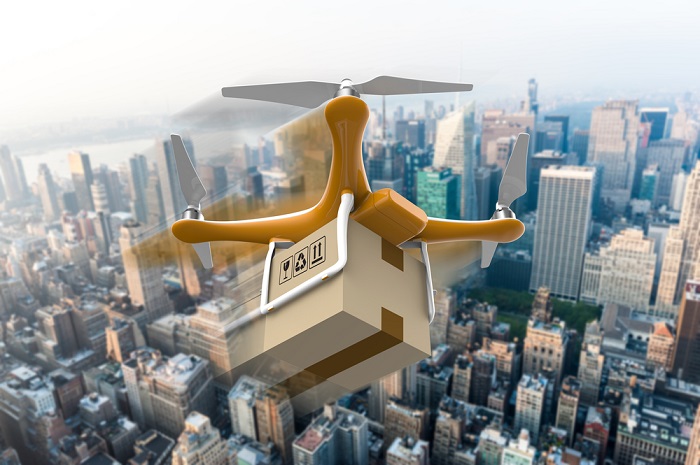
Key markets around the world have been experiencing a shortage of delivery drivers in recent years. So much so, in the UK Amazon enticed part-time workers with up to £3,000 (US$3,600) in incentives to ensure this didn’t affect profits during the festive period.
According to the Road Haulage Association, the UK industry alone was short of more than 100,000 HGV drivers in June 2021. This was due to a number of factors, from barriers to obtaining a licence to the introduction of Brexit, but similar shortages are seen in other regions as well. In order to address these shortages, companies around the world are coming up with innovative alternatives. This includes the introduction of unmanned aerial vehicles (UAVs). Alphabet, for example, has successfully used these to deliver over 10,000 cups of coffee and 1,000 loaves of bread in Logan, Australia alone. Are UAVs the solution?




Can we rely on UAVs?
Commercial UAVs are leading the way for innovative research. In addition to delivery services, drones are being utilised for wildlife protection and research, historical preservation, and the improvement of renewable energy resources. However, before the mass distribution of delivery drones, businesses and customers alike must decide if they are reliable. The thought of unmanned vehicles might seem concerning at first, but technological innovations are ensuring this is a safe and dependable process.
Alex Stapleton, Sales Director at Alexander Technologies, a leading provider of customised lithium-ion batteries and chargers, shines a light on the use of UAVs: “The question of how to power a UAV or drone is influenced significantly by the nature of the application. In some cases, particularly for the largest equipment, combustion engines are still designed into this market, but more and more models are being designed to run on lithium-ion batteries.”
Lithium-ion battery packs are powerful, comparatively small and light and can be charged quickly. More recently, some have started to use efficient solar panels within the design to extend the range and preclude the need for a dedicated charger at both ends of a flight path. Silent running, vertical take-off and landing (VTOL) capabilities are attractive, as is the environmental benefit of designing away from the combustion solution.
“Batteries are particularly effective at the moment for short-range missions, similar to the last-mile delivery solutions, to increase bandwidth at the local delivery hub,” says Stapleton. “They are more practical when delivering small-sized payloads. Perfecting the design of this solution is critical to successful new development, and this is usually best achieved through iterative discussions around the application itself and key challenges—such as charging time, operating temperature or capacity.”
What are the benefits?
UAVs are becoming the next futuristic piece of technology to dominate the delivery market. Vikram Singh, Chief Executive of TechEagle, a company that has delivered over a thousand packages in India, believes that delivery drones are the future: “Drones are autonomous, faster, more reliable, and more economical than conventional delivery methods.”
There are multiple benefits to using a drone delivery service, including environmental perks. In fact, research shows that drones use less energy per kilometre than traditional delivery trucks. They are smaller and powered by batteries, after all, reducing the amount of carbon dioxide entering the atmosphere.
In addition to any ecological benefits, delivery drones are a more efficient service. So much so, the owner of TechEagle has gone on to argue that his company’s drones have the ability to deliver parcels 20 times faster than any ground-based method of transportation. Over time, this will build a long-lasting relationship between customers and businesses.
Finally, drones are proving to be a more cost-effective delivery service. Due to the fact that drones can deliver seven to eight packages within an hour, considerably more than standard ground-based services, businesses will save money on both wages and fuel
To summarise
UAVs are on their way to becoming the solution to delivery shortages. Companies around the world are adopting this approach, from Alphabet in Australia to TechEagle in India. In Ireland, drone company Manna is trialling processes in Galway, according to Chief Executive Bobby Healy. Over time, this can reduce company costs and environmental emissions.

