
The next generation of soft robotics, smart clothing, and biocompatible medical devices are going to need integrated soft sensors that can stretch and twist with the device or wearer. The challenge: most of the components used in traditional sensing are rigid. Now, researchers at the Harvard John A. Paulson School of Engineering and Applied Sciences (SEAS) have developed a soft, stretchable, self-powered thermometer that can be integrated into stretchable electronics and soft robots.
“We have developed soft temperature sensors with high sensitivity and quick response time, opening new possibilities to create new human-machine interfaces and soft robots in healthcare, engineering, and entertainment,” said Zhigang Suo, the Allen E. and Marilyn M. Puckett Professor of Mechanics and Materials at SEAS.




The thermometer consists of three simple parts: an electrolyte, an electrode, and a dielectric material to separate the two. The electrolyte/dielectric interface accumulates ions while the dielectric/electrode interface accumulates electrons. The charge imbalance between the two sets up an ionic cloud in the electrolyte. When the temperature changes, the ionic cloud changes thickness and a voltage is generated. The voltage is sensitive to temperature but insensitive to stretch.
“Because the design is so simple, there are so many different ways to customize the sensor, depending on the application,” said Yecheng Wang, a postdoctoral fellow at SEAS. “You can choose different materials, arranged in different ways and optimized for different tasks.”
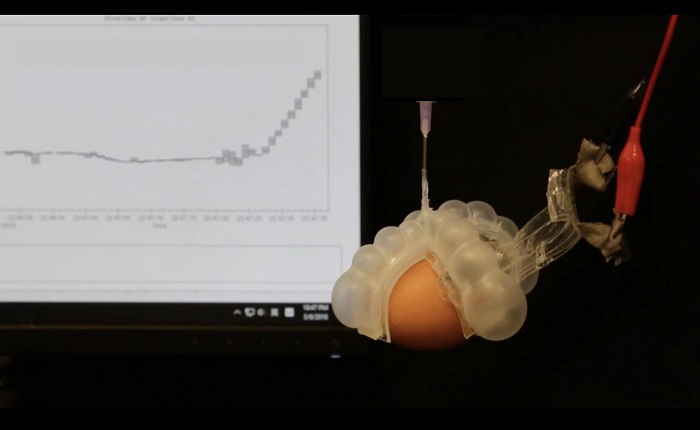
By arranging the electrolyte, dielectric, and electrode in different configurations, the researchers developed four designs for the temperature sensor. In one test, they integrated the sensor into a soft gripper and measured the temperature of a hot hard-boiled egg. The sensors are more sensitive than traditional thermoelectric thermometers and can respond to changes in temperature within about 10 milliseconds.
“We demonstrated that these sensors can be made small, stable, and even transparent,” said Wang.
Depending on the materials used, the thermometer can measure temperatures upwards of 200 degrees Celsius or as cold as -100 degrees Celsius.
“This highly customizable platform could usher in new developments to enable and improve the internet of everything and everyone,” said Suo.

