
HomeTechnologyAutomation and RoboticsReducing the Power Consumption with Neuromorphic Chip

    Reducing the Power Consumption with Neuromorphic Chip

    A team of researchers at Tsinghua University’s Center for Brain-Inspired Computing Researcher has developed a neuromorphic chip that can reduce the power consumption of a cat-and-mouse-type rolling robot by approximately half, compared to a conventional NVIDIA chip designed for AI applications. The group describes the design concepts they used to build the chip and how well it worked when tested.

    As AI applications mature, they become more complex and require more power to run, which can be a problem for autonomous robots working in the field. Most of these systems are based on the use of neural networks. In this new effort, the researchers believed that building a chip with similar abilities but based on neuromorphic computing technology would use far less power. They built a neuromorphic chip called TianjicX and put it in a small rolling robot called Tianjicat.

    The chip was imbued with spatiotemporal elasticity that allowed for the adaptive allocation of its resources and also the scheduling of multiple tasks (the robot had to be able to keep track of the mouse and chase it, while at the same time processing and responding to information about obstacles). It also had a high-level module that bridged the gap between the requirements given and the physical architecture of the robot.

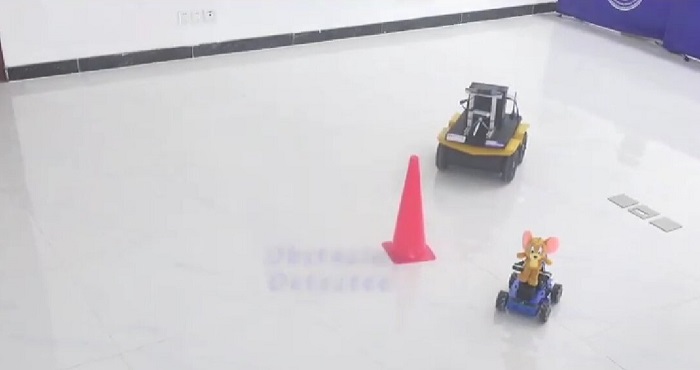
    Tianjicat was then programmed to follow a target and avoid running into obstacles using data from onboard sensors. The target in this case was a rolling, remote-controlled toy with a cartoon mouse affixed to its top. The researchers referred to it as a cat-and-mouse challenge.

    The researchers found the mechanical cat quite capable of chasing the mouse while avoiding obstacles. It also was able to catch the mouse. Tianjicat used just over 50% less power than an identical NVIDIA chip-based robot. And they also found that their neuromorphic chip-based robot had markedly reduced latency—79 times less than the NVIDIA-based system, allowing the robot to make decisions much faster.

    ELE Times Research Desk
    ELE Times Research Deskhttps://www.eletimes.ai
    ELE Times provides extensive global coverage of Electronics, Technology and the Market. In addition to providing in-depth articles, ELE Times attracts the industry’s largest, qualified and highly engaged audiences, who appreciate our timely, relevant content and popular formats. ELE Times helps you build experience, drive traffic, communicate your contributions to the right audience, generate leads and market your products favourably.

    Related News

    Must Read

    Top Seven Tech Trends in the semiconductor sector for 2026

    By: STMicroelectronics In 2026, a new class of intelligent machines...

    Keysight launches next-gen Infiniium XR8 Oscilloscopes for faster analysis, clearer insights, and a compact design

     Keysight Technologies introduced its next-generation Infiniium XR8 Real-Time oscilloscopes,...

    R&S showcases its comprehensive embedded systems test solutions at embedded world 2026

    Rohde & Schwarz will present its advanced test and...

    Toxics Link study Finds a Long Road to Circularity in India’s E-waste EPR Model

    A new report by an environmental group, Toxics Link,...

    ESGDS’ AI platform slashes data processing time by 98% with MongoDB Atlas

    ESG Data & Solutions (ESGDS) is a fast-growing Indian...

    Keysight Unveils 3D Interconnect Designer for Chiplet and 3DIC Advanced Package Designs

     Keysight Technologies introduced 3D Interconnect Designer, a new addition to...

    Jodi Shelton, CEO of GSA – Launches A Bit Personal, a New Podcast Offering Rare, Candid Conversations with the Most Powerful Tech Leaders

    Jodi Shelton, Co-Founder and CEO of the Global Semiconductor Alliance and Shelton...

    Is SDV Really an Automotive or Just A Software-based machine That Moves?

    Speaking at the Auto EV Tech Vision Summit 2025,...

    ROHM’s New Compact, Highly Reliable Package Added to Automotive 40V/60V MOSFET Lineup

    ROHM has expanded its lineup of low-voltage (40V/60V) MOSFETs...


