
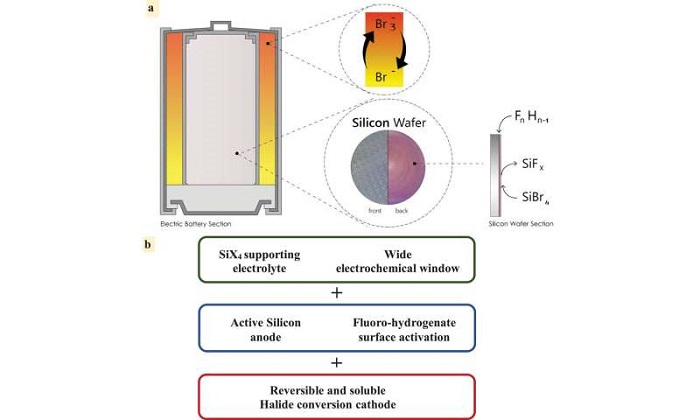
A team of researchers from the Technion–Israel Institute of Technology has developed a proof-of-concept for novel rechargeable silicon (Si) batteries, as well as its design and architecture that enables Si to be reversibly discharged and charged.
Led by Professor Yair Ein-Eli of the Faculty of Materials Science and Engineering, the team proved via systematic experimental works of the graduate student, Alon Epstein, and theoretical studies of Dr. Igor Baskin, that Si is dissolved during the battery discharge process, and upon charging, elemental Si is deposited. Several discharge-charge cycles were achieved, utilizing heavy doped n-type Si wafer anodes and specially designed hybrid-based ionic liquid electrolytes, tailored with halides (Bromine and Iodine), functioning as conversion cathodes.




This breakthrough could pave the way towards the enrichment of the battery technologies available in the energy storage “super-market” technology, providing ease to the ever-growing market and demand for rechargeable batteries.
Developments leading to this breakthrough
The increased demand for sustainable energy sources prompted the scientific community to focus on battery research capable of storing large-scale grid energy in a manageable and reliable manner. Moreover, the rising demand of the EV industry, which mainly relies on current Li-ion batteries (LIBs) technology is expected to strain current Li production and divert it from more widespread use as portable consumer electronics. Currently, no technology has proven to be competitive enough to displace LIBs. Metals and elements capable of delivering multi-electrons during their oxidation process have been the focus of the research community for a long time due to their associated high specific energy densities.
Magnesium, calcium, aluminum, and zinc received much attention as potential anode materials with varying levels of progress; yet none has managed to revolutionize the energy storage industry beyond LIBs, as all of these systems suffer from poor kinetic performance to lack of cell stability, and therefore, much is left to be explored. Silicon (Si), as the second most abundant element on earth’s crust (after oxygen), was left relatively unexplored despite a high energy density of 8.4 kWh kg-1 on par with metallic Li 11.2 kWh kg-1; Si possesses stable surface passivation, low conductivity (dependent on the doping levels) and until now no established rechargeable cell chemistry comprising elemental Si as an active anode has been reported, outside LIB alloying anode.
The incorporation of active Si anodes in primary, non-rechargeable air-battery designs. Thus, despite its high abundance and ease of production, the possibility of using Si as an active multivalent rechargeable anode was never explored, until the team’s recent breakthrough.

