
Automotive radar systems have become a cornerstone of advanced driver-assistance systems (ADAS), enabling object detection, collision avoidance, blind-spot monitoring, and adaptive cruise control. As vehicle autonomy advances toward higher SAE levels, radars are evolving with greater resolution, longer range, and multi-object tracking capabilities. But with this leap in performance comes the pressing challenge: how to test these increasingly complex systems with the accuracy and repeatability needed for safe deployment on public roads.
Technology Environment: 24 GHz to 77 GHz and Higher:




The environment of automotive radar is changing quickly. Due to bandwidth constraints and stricter spectrum laws, traditional 24 GHz radars once common for short-range applications like parking assistance and cross-traffic alerts are currently being phased out.
Radars operating at 77 GHz are replacing them as the new norm. They provide a greater bandwidth, longer detection ranges, better range resolution, and more robust interference resistance. For mid- to long-range ADAS features like adaptive cruise control, lane-change assistance, and automated emergency braking, they are therefore essential. However, there is a cost and design complexity trade-off.
At the same time, radar sensing has evolved from 2D to 4D imaging radar. Conventional 2D radars could measure distance and velocity but lacked elevation, limiting object classification in dense traffic. By contrast, 4D imaging radars measure distance, velocity, azimuth, and elevation simultaneously producing LiDAR-like point clouds enriched with Doppler data. This technology thrives in poor weather conditions like fog, rain, or snow, where optical sensors struggle, making it indispensable for L2+ through L4 autonomy.
Radar Test Architecture:
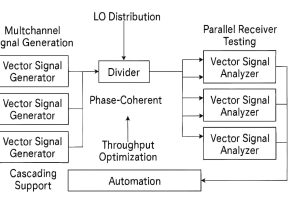
Radar Test Architecture for Automotive Applications: Phase-Coherent Multichannel Signal Generation, LO Distribution, and Parallel Receiver Testing with Automation Flow
This diagram illustrates a radar test setup optimized for automotive radar validation. It begins with multichannel vector signal generators that ensure phase coherence and support cascading for scalable configurations. The signals are routed through an LO distribution divider, feeding synchronized local oscillator signals to multiple vector signal analyzers for parallel receiver testing. At the base, an automation controller manages the test flow, enabling throughput optimization across channels.
Latest Trends in Radar Testing:
As radar performance expands, testing methodologies are transforming as well. Today’s radar testers are not only tasked with validation under ideal conditions but also with simulating real-world unpredictability before vehicles even hit the road.
- 4D Radar Simulation
Virtual test environments can replicate rain, snow, fog, and multipath reflections that are impractical to test on real roads. These simulations are vital for developing next-gen 4D radars.
- Hardware-in-the-Loop (HiL) Testing
HiL connects real radar hardware with a simulated driving environment. This allows engineers to test radar responses to cars, pedestrians, and traffic scenarios entirely in the lab—reducing cost and speeding up development.
- AI-Enhanced Radar Validation
AI plays an increasing role by detecting subtle anomalies in radar signals, generating rare accident-like scenarios, and predicting radar degradation. This accelerates validation cycles compared to manual testing.
- Sensor Fusion Testing
Since radars rarely operate alone, test systems now validate how radars integrate with cameras and LiDAR. Ensuring all sensors remain synchronized and error-free is critical to the safety of self-driving systems.
Industry Insights: Keysight Technologies at the Forefront
As automotive radar systems evolve to meet rising demands for higher resolution and precision, Keysight Technologies stands at the forefront of testing innovation. With chipset vendors adopting cascading architectures to boost transmit and receive channel counts, radar complexity is increasing alongside the need for more rigorous and extended test cycles. Natarajan Mahesh from Keysight’s Radar Testing Team highlights this shift as a key challenge in next-gen radar development.
“Automotive radar chipset vendors are looking to increase the transmit and receive channel count to cater to the increasing demand for better resolution using methods such as cascading radar chipsets. The higher channel count of receiver and transmitters will essentially mean more test time.” — Natarajan Mahesh, Radar Testing Team, Keysight Technologies
Keysight Technologies is addressing this challenge with specialized solutions that balance complexity with efficiency:
- Coherent Multichannel Signal Generators – providing compact, phase-aligned outputs with excellent phase noise.
- Local Oscillator Distribution – delivering stable, low-noise signals for cascading architectures.
- Simultaneous Multi-Channel Stimulus – enabling parallel receiver testing and cutting down test duration.
- Radar-Specific Test Automation – supporting MIMO radar, FMCW waveforms, and Doppler emulation.
Keysight also extends its scope into cybersecurity with its SA8710A Automotive Cybersecurity Test Platform, ensuring that radar systems in connected vehicles are validated not just for performance but also for resilience against digital threats.
“Keysight Technologies has solutions for the autonomous vehicle and in-vehicle communication systems, of which radar is one of the most critical sensors.”

Future Outlook:
- Fully Virtualized Validation: AI and physics-based simulations work together to provide nearly comprehensive test coverage prior to in-person trials.
- 5G-Connected Testbeds: over-the-air (OTA) firmware optimization and cloud-based radar analytics.
- Automated Test Labs: these robotic devices simulate targets dynamically from various perspectives.
- 4D radar standardization: frameworks for industry-wide certification that establish consistent performance benchmarks.
Conclusion:
Automotive radar testers are critical enablers of the next wave of ADAS and autonomy. As radars evolve from basic range-speed sensors to high-resolution 4D imaging systems, test platforms must evolve as well becoming simulation-rich, AI-driven, and fusion-aware.
Companies like Keysight Technologies are leading this transformation, ensuring that radar-equipped vehicles perform safely, reliably, and securely under all conditions ultimately paving the way toward fully autonomous driving.

