

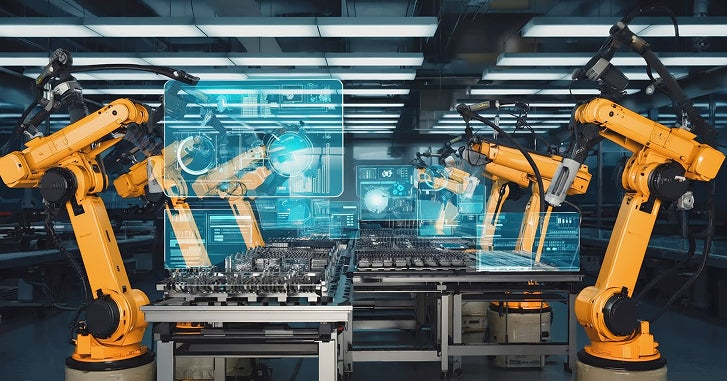
The world of manufacturing is changing very fast with digital intelligence merging with the conventional industrial processes. Physical AI lies at the heart of this revolution, bringing together sophisticated algorithms and machinery such as robotic arms, autonomous guided vehicles (AGVs), and CNC machinery. For these systems based on AI to function optimally, they depend on real-time information from industrial sensors. Serving as the “eyes and ears” of machines, sensors today do much more than make measurements they allow AI systems to learn, adapt, and optimize processes to enhance productivity, safety, and efficiency.
The two-part series addresses how industrial sensors enable physical AI applications. The first part discusses sensor types and functions in smart factories, while the second part will discuss innovations and trends that will dominate next-generation physical AI-powered industrial systems.



How Industrial Sensors Enable Physical AI
Industrial sensors measure physical parameters like motion, distance, pressure, temperature, or flow into electrical signals that undergo parameterization. These signals find their way into PLCs, CNC machines, and edge AI devices that carry out real-time decision making.
A typical sensor has some or all of these components: sensing element, operational amplifier OpAmp, ADC, processor, interface, and power management. All these or some of them constitute the sensor acting as a bridge between AI algorithms and the physical world, much like the nervous system transmitting information to the brain.
With a modern smart factory, there is an increase in the deployment of AI at the edge, embedding algorithms in sensors, robots, and controllers themselves. This obviates decision making in real-time being made on cloud-based IT systems alone.
Key Industrial Sensor Types
Vision (Image) Sensors: Cameras used to capture product images for machine vision, inspection, and quality control. They recognize orientation, defects, and positioning in real time. Next-generation short-wave infrared (SWIR) and low-power image sensors provide high dynamic range and low-light capabilities in demanding industrial settings.
Position & Torque Sensors: Hall-effect, optical, and inductive sensors are used to detect motor position and torque. Latest inductive PCB-based sensors combine analog front-ends and controllers to make mechanical design easier while providing improved temperature tolerance and contamination resistance.
Ultrasonic Sensors: Detect distance by emitting ultrasonic waves. Suitable for detecting transparent objects, ultrasonic sensors are widely applied in autonomous robots for navigation and obstacle detection and in process automation for flow and level measurement.
Photoelectric Sensors: Capture objects using light-based technologies infrared or laser and come in through-beam, retroreflective, and diffuse-reflective configurations. They are non-contact, flexible, and accommodate long detection ranges.
Proximity Sensors: Sense metallic objects using electromagnetic induction without contact. They are durable in harsh environments and can be used in conjunction with ultrasonic or photoelectric sensors to detect non-metallic objects.
Pressure Sensors: Condition clean-room environments and pneumatic or hydraulic systems. They deliver accurate voltage readings that represent system pressure using strain gauges or force resistors.
Temperature Sensors: Monitor and control temperature in various industries. Thermocouples, RTDs, and semiconductor temperature sensors protect machinery and stabilize processes.
Environmental Sensors: Add gas, chemical, rain, and light sensors to measure environmental conditions and workplace safety. For example, electrochemical sensors can measure chemical currents at low power consumption, providing constant monitoring.
Selecting the Correct Sensors for Intelligent Manufacturing
When designing industrial systems with AI, engineers should keep in mind:
- Application Response Speed & Accuracy: Response speed and accuracy should be suited to the job, from control of robots to quality inspection in real time.
- Data Reliability: Sensors need to deliver high-quality data reliably to enable AI learning and analytics.
- Integration & Interoperability: Sensors need to integrate seamlessly with PLCs, field buses, and other industrial automation.
- Data Privacy & Cybersecurity: Preserving sensitive operating data is essential, particularly as sensors communicate data through networks.
- Energy Efficiency: Sensors with low power consumption allow widespread deployment without exceeding power budgets.
Conclusion:
Industrial sensors are critical to enable physical AI in the smart factory spaces. By sensing the physical world accurately and interpreting it, these sensors enable AI systems to make quicker, wiser, and more secure decisions. With advancements in sensor technologies, they will further propel more intelligent, adaptive, and more sustainable industrial activities, leading the way to Industry 5.0.
With its extensive sensor portfolio and application know-how, Onsemi continues to be the leader in intelligent sensing, assisting manufacturers to unlock the full value of physical AI.
(This article has been adapted and modified from content on Onsemi.)

