
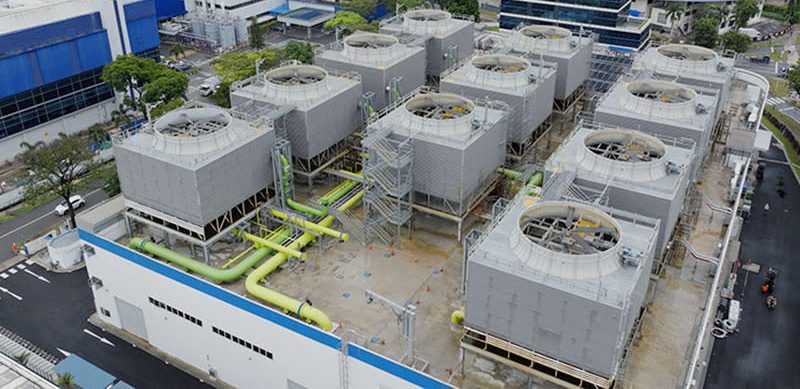
STMicroelectronics and SP Group (SP) have commenced operations for Singapore’s largest industrial district cooling system at STMicroelectronics’ (ST) Ang Mo Kio TechnoPark. The event was inaugurated by Ms. Low Yen Ling, Senior Minister of State, Ministry of Trade and Industry and Ministry of Culture, Community and Youth.
The system is expected to reduce carbon emissions by up to 120,000 tonnes per year and enable 20 per cent savings on cooling-related electricity consumption. It will also repurpose over half a million cubic meters of water each year by using reject reverse osmosis water, previously used in ST Cooling Towers, to support the new district cooling operations.



This marks ST’s first use of district cooling at a manufacturing facility and will strengthen ST’s commitment to be carbon neutral by 2027.
“The deployment of Singapore’s largest industrial district cooling system at our Ang Mo Kio TechnoPark demonstrates our commitment to pioneering energy-efficient solutions that reduce carbon emissions and conserve resources. This achievement strengthens our partnership with Singapore in advancing its national sustainability goals,” said Rajita D’Souza, President of Human Resources and Corporate Social Responsibility at STMicroelectronics. “By integrating advanced technologies like the district cooling system, we are driving a smarter, more sustainable future — showcasing how industry leadership and environmental stewardship align to create lasting value for our business, communities, and the planet.”
“SP Group’s strategic partnership with STMicroelectronics marks a pivotal milestone in our nation’s transition towards a low-carbon future. This project showcases how collaborative innovation can transform urban infrastructure to deliver sustainable, energy-efficient solutions. District cooling will continue to play a vital role in Singapore’s net-zero ambitions, enabling carbon emissions reduction and enhancing energy resilience across industrial and urban developments,” said Stanley Huang, SP’s Group Chief Executive Officer.
Technical details of the district cooling system
Designed, built, owned, and operated by a joint venture between SP and Daikin Airconditioning (Singapore), the system has an installed capacity of up to 36,000 refrigeration tonnes (RT). It delivers continuous chilled water to cool both manufacturing and office spaces via a centralized closed-loop pipe network replacing individual chillers in each building. The total area served by the system is approximately 90,000 square metres.
Chillers in series counterflow configuration reduce the energy required to cool the water. This ensures an efficient and reliable 24/7 operation, with remote monitoring capabilities augmenting the operations team on site to come.
“This partnership with SP reflects Daikin’s commitment to delivering advanced, energy-efficient solutions that go beyond immediate operational needs. Our goal is to contribute to a more sustainable built environment, where technology plays a key role in enhancing resilience, reducing environmental impact, and supporting Singapore’s long-term climate ambitions,” said Chua Ban Hong, Managing Director at Daikin Airconditioning (Singapore).
Additionally, the new installations free up around 4,000 square meters of space at Ang Mo Kio TechnoPark, which will enable ST to install other equipment contributing to environmental impact mitigation. This includes perfluorocarbon (PFC) abatement equipment, with near-future plans for additional water reclamation systems and volatile organic compounds (VOC) abatement as part of its ongoing sustainability efforts.

