
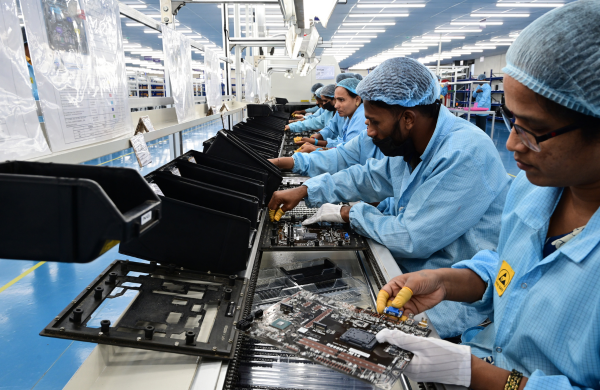
The Union Budget 2026-27 presented in the parliament on 1st February, 2026, allocates Rs 40, 000 crore to the Electronics Components Manufacturing Scheme (ECMS) launched last year in April. With a proposed budgetary outlay of around Rs 40,000 Crore for the Electronics Components & Manufacturing Scheme (ECMS), as compared to the previous outlay of Rs 22,919 crore during its launch in April 2025, the government intends to ensure that India’s electronics components game goes up globally. The outlay is being doubled even as the scheme “already has investment commitments at double the target,” and the near-doubling of the outlay will “capitalise on the momentum,” she says.
The increased budgetary outlay will highly benefit the electronics sector in India as it aims to promote the domestic manufacturing of electronics components that the nation really needs at this time, so as to become the real electronics hub globally. It promotes the manufacturing of Printed Circuit Boards (PCBs), lithium-ion Cells and other necessary electronics components used in modern-day devices ranging from mobile phones to automobiles.




Commitment to Mnaufacturing-led Growth
Commenting on the Budget, Mr. Pankaj Mohindroo, Chairman, ICEA, says, “Budget 2026–27 reinforces the government’s commitment to manufacturing-led growth, particularly in electronics and semiconductors, through continuity, scale, and targeted reforms.”India Cellular & Electronics Association (ICEA) is India’s apex industry body representing the entire mobile and electronics ecosystem. “Measures such as the expansion of ECMS, support for ISM 2.0, and long-term incentives for cloud and data infrastructure send a strong signal of strategic intent and policy stability,” he adds.
The EMS Component in GDP to Increase
The intent behind the budgetary outlay speaks volumes about the government’s vision for the electronics industry. Talking about this very thing, Mr Jasbir Singh, Executive Chairman and CEO, Amber Enterprises, welcomes the governmnet’s decision to increase the budgetary outlay. He says,” Cementing this further, the decision to establish high-tech tool rooms to manufacture high-precision components at scale and lower cost will propel India to become self-reliant and globally competitive.”
He also commends the government’s decision to rejuvenate 200 legacy industrial clusters, which will boost the EMS sector tonexponential growth. He adds,” These policies will increase the EMS contribution to the GDP, expected to be the third-largest.”
A Mighty Scheme
The scheme has approved 46 projects so far, attracting cumulative investments of ₹54,567 crore, with projected production valued at ₹3.68 trillion and the creation of over 50,000 direct jobs. Notified with a six-year budgetary outlay of ₹22,919 crore, the scheme envisages a total production of ₹10.34 lakh crore and employment generation for nearly 142,000 people. It is designed to lay the groundwork for a $500-billion electronics manufacturing ecosystem by 2030–31.

