
The digitisation of the railway sector has picked up steam: cable-based communication in rail vehicles is growing in response to WiFi usage, passenger information systems and additional sensors and assemblies for electronic monitoring and control. The growing volume of data is becoming increasingly important for the various players in the railway sector.
In order to meet the need for communication on board trains, rail vehicles need powerful networks and interfaces that fit the specific requirements on the rail market. Another important factor is a high transmission speed: railway operators have decided on Cat. 7A as a future standard. This allows transmission in the frequency range up to 1,000 MHz.



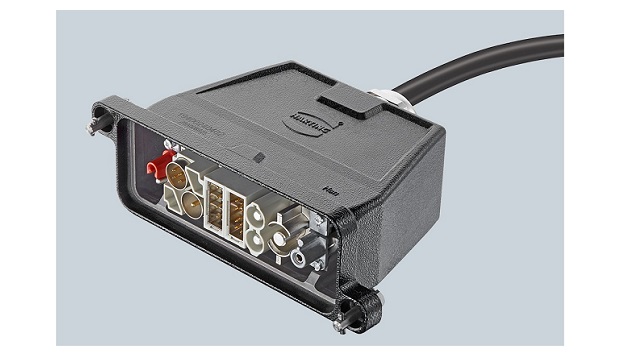
The Han Gigabit Module is the first matching modular connector to meet this requirement. The advantages: signal integrity improves significantly versus Cat. 6A. Shielding against interference also benefits, as Cat. 7A cables consist of four individually screened wire pairs which are surrounded by another screen braid.
The new Han Gigabit module enables Cat. 7A transmission in the train car transition area and offers advantages for interference resistance and frequency range. The interface is also shock and vibration resistant according to DIN EN 61373, Category II, which makes it suitable for extreme loads in the railway environment. The module already permits the installation of the Ethernet backbone for future facilities, upgrades and conversions of rail vehicles.
Position detection and state detection via RFID and MICA
HARTING not only supports flexible data exchange on the train with unmanaged switches and patch cables. In a chain comprised of sensors, antennas, RFID readers and MICA, the latter serves as an Edge computer for filtering, aggregating and compressing the sensor data, ambient data can be recorded wirelessly in the periphery and digitally processed for control purposes. The MICA platform translates the sensor data from the RFID reader and makes it available to other participants in the bus system in filtered form and reduced to the required extent.
HARTING’s open hardware and software platform thus promotes digitisation in various directions: here, the MICA acts as an intermediary between the data protocols of manufacturers of independent systems.

