
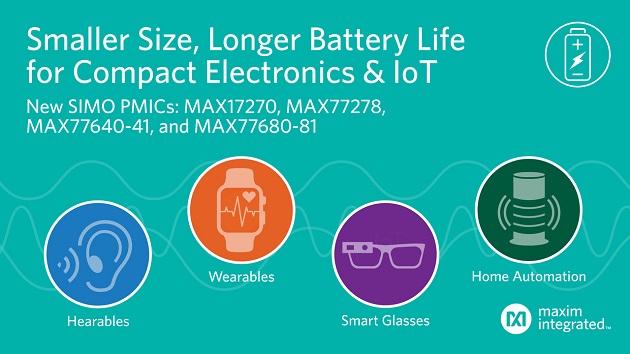
Designers of small, battery-powered electronics can enhance the user experience by extending battery life and further shrinking device size with six new low-power power-management integrated circuits (PMICs) from Maxim Integrated Products, Inc.. The MAX17270, MAX77278, MAX77640/MAX77641 and MAX77680/MAX77681 PMICs help to reduce the power-management footprint by up to 50 percent for space-constrained products such as wearables, hearables, sensors, smart-home automation hubs and internet of things (IoT) devices.
They increase the overall system efficiency by nine percent compared to the closest competitive solution, while also reducing heat dissipation, an important consideration for wearable products that make skin contact.




Designers are striving to make electronic gadgets more integral in consumers’ lives by scaling down their form factor, reducing heat, improving efficiency and extending battery life. Meeting each of these criteria is a formidable challenge given the rich feature sets, lower thermal thresholds and smaller capacity batteries required to achieve increasingly compact solution sizes.
MAX17270: Smallest Size and Lowest Quiescent Current
At 50 percent smaller than previous-generation SIMO-only solutions, the MAX17270 SIMO buck-boost converter provides the industry’s smallest solution size while reducing the number of inductors and ICs that are required for a power tree. Its quiescent current of 850nA for one SIMO channel and 1.3µA for three SIMO channels is the lowest in the market and helps extend battery life of end devices.
MAX77278: Power Path Charger Optimized for Small Li+ Batteries
This ultra-low-power SIMO PMIC provides three buck-boost regulators with independent voltage outputs (0.8VOUT to 5.25VOUT), 16µA operating quiescent current/300nA standby current and flexible power sequencing. The device is also a charger for small Li+ cells (7.5mA – 300mA CC range). It includes an adjustable 425mA current sink for an LED, eight general-purpose input/output (GPIO) pins and a 3.7125V to 5.3V, 50mA low-noise low-dropout regulator (LDO) with fixed headroom control in a total solution size as low as 24mm2.
MAX77640/MAX77641: Highly Integrated Battery Charging and Power Solutions
These ultra-low-power SIMO PMICs feature three buck-boost regulators, a low-noise 150mA LDO, a GPIO output port, a triple current sink for an RGB LED array and flexible power sequencing. Operating current is just 5.6µA and shutdown current is 300nA.
MAX77680/MAX77681: Mini PMICs for Always-On, Low-Power Applications
These ultra-low-power SIMO PMICs provide three buck-boost regulators, 3.0µA operating quiescent current, 300nA shutdown current and flexible power sequencing. Total solution size is only 15.5mm2.
“The challenge facing developers is how to include the processor, high-quality audio, near-field communication, wireless connectivity and multiple sensors in wearable form factors that conserve precious battery life and manage the thermals, given that these devices often come in contact with heat-sensitive skin,” said Karthi Gopalan, director of business management, Mobile Power Business Unit, Maxim Integrated. “These SIMO PMICs continue our tradition of providing one-stop power management solutions for a wide range of next-generation, low-power designs.”
For more info, log on https://www.maximintegrated.com

