
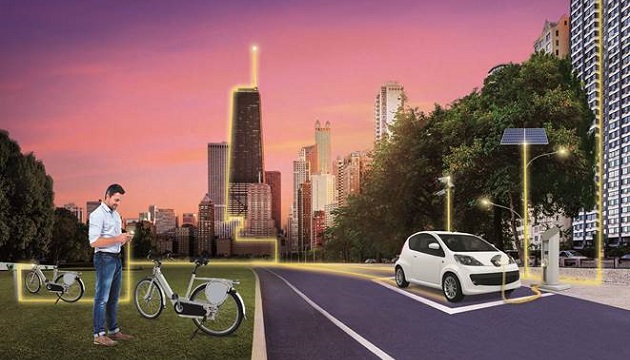
More and more people are moving into cities. And the growing shortage of space and resources is a huge challenge for municipalities. The smart city – a connected and intelligent conurbation – is a solution to these problems. The use of digital technologies makes cities safer, more efficient and increasingly sustainable. Light + Building 2020, the world’s leading trade fair for the sector in Frankfurt, presents products for the smart city and provides a platform for smart building automation, intelligent energy management and connected safety and security.
Technological developments and innovations play a key role in the concepts of tomorrow’s cities. The main prerequisite for the smart city of the future is the safe, secure and efficient connection of people, places and their infrastructure. Today, the intensive linkage and collection of data from building equipment is already reality.




Smart buildings – nucleus of a smart city
The process of urbanisation means the amount of ground available is declining – and buildings are becoming ever bigger, higher and more complex. Collecting and evaluating a large volume of data can help improve the safety, security, energy efficiency and environmental friendliness of buildings and cities. By completely networking numerous sensors, the data amassed will be available to all services and thus ensure, inter alia, lower energy consumption. According to the Association of the German Electrical Industry (ZVEI), intelligent building automation can generate savings of 20 to 30 percent in terms of energy demand and CO2 emissions. In this connection, self-learning systems can promote intensive user involvement through, for example, needs-based control of light, air conditioning and heating, or through the display of individual escape routes on mobile devices.
Smart Lighting – an important contribution to energy saving
According to the Working Group on Energy Balances some 13 percent of electricity consumption in Germany goes on lighting. With energy savings of up to 80 percent, LED luminaires offer a huge potential compared to conventional lighting systems. Moreover, their light temperature and colour can be adjusted to suit individual requirements.
In this way, smart LED luminaires can be used to increase well-being and productivity (human centric lighting). In intelligent cities, LED streetlights fitted with WLAN, charging facilities for electric cars, an emergency-call button and other sensors are an important part of the Internet of Things (IoT).
Electric charging infrastructure – the core element for smart Mobility
Smart cities are only possible with new mobility concepts and the intensive expansion of electromobility is one of the keys to this.
Consequently, it will be necessary to provide charging points for electrical vehicles and an intelligent charge-management system in an intelligent electricity network (smart grid). In this connection, particular attention must be paid to the integration of charging points in the electrical infrastructure of a building, which must be adapted accordingly.
Light + Building: market overview and discussion platform
Tomorrow’s challenges, such as urbanisation and climate change, can only be met with innovative ideas and approaches. An intensive exchange of information between everybody involved is essential if we are to get beyond individual measures and pilot projects. Light +Building, the world’s leading trade fair for the sector in Frankfurt am Main from 8 to 13 March 2020, is the ideal platform for discussing concepts relating to building automation, the smart city, intelligent neighbourhood and energy management, progressive e-charging infrastructure and connected safety and security.
For more information, visit: www.messefrankfurt.com

