
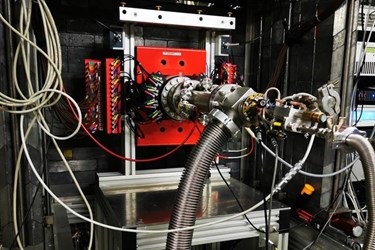
Researchers, by exploiting the complex quantum properties of electrons – in this case, the spin state of electrons, have announced in the journal Science Advances that they have created a ‘spin capacitor’ that is able to generate and hold the spin state of electrons for a number of hours – compared to previous attempts that have only ever held the spin state for a fraction of a second.
Researchers at the University of Leeds have reported a breakthrough in the development of a new generation of electronics that will require less power and generate less heat.




That ability now opens up the possibility that new devices could be developed that store information so efficiently that storage devices could get very small. A spin capacitor measuring just one square inch could store 100 Terabytes of data.
A spin capacitor is a variation on a traditional capacitor. Instead of holding just charge, it also stores the spin state of a group of electrons – in effect it ‘freezes’ the spin position of each of the electrons.
This is a small but significant breakthrough in what could become a revolution in electronics driven by exploitation of the principles of quantum technology. At the moment, up to 70 per cent of the energy used in an electronic device is lost as heat, and that is the energy that comes from electrons moving through the device’s circuitry. It results in huge inefficiencies and limits the capabilities and sustainability of current technologies. The carbon footprint of the internet is already similar to that of air travel and increases year on year.
With quantum effects that use light and eco-friendly elements, there could be no heat loss. It means the performance of current technologies can continue to develop in a more efficient and sustainable way that requires much less power.”
The research shows that the devices of the future may not have to rely on magnetic hard disks. Instead. They will have spin capacitors that are operated by light, which would make them very fast, or by an electrical field, which would make they extremely energy efficient.
With quantum technology, spin capacitors could write and read information coded into the spin state of electrons by using light or electric fields.
The research team were able to develop the spin capacitor by using an advanced materials interface made of a form of carbon called buckminsterfullerene (buckyballs), manganese oxide and a cobalt magnetic electrode. The interface between the nanocarbon and the oxide is able to trap the spin state of electrons.
The time it takes for the spin state to decay has been extended by using the interaction between the carbon atoms in the buckyballs and the metal oxide in the presence of a magnetic electrode.
The scientists involved in the project believe the advances they have made can be built on, most notably towards devices that are able to hold spin state for longer periods of time.

