
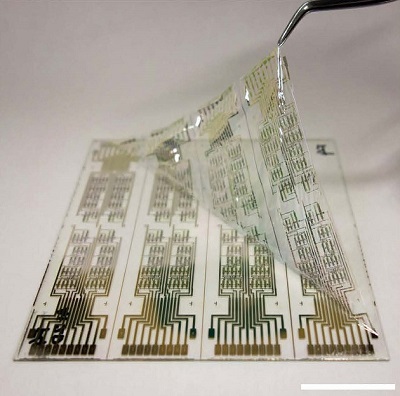
The Global Organic Electronics Market size is expected to reach $145.3 billion by 2026, rising at a market growth of 22.3% CAGR during the forecast period.
Organic electronics is a division of electronics that deals with the formulation design, and application of organic materials that have electrical properties. The organic materials that are used are mainly organic compounds that exhibit substantial electrical properties such as conductivity. These organic materials are made up of small molecules or carbon-based polymers, hereafter also called plastic electronics or polymer electronics. Organic electronics facilitate the benefit of low manufacturing cost compared to that of conventional inorganic electronics. Organic electronics are eco-friendly and offer better utilization of the resource.




Devices that are made with organic materials are considered to have a better interfacing ability with biological systems compared to inorganic materials. Improved biocompatibility of organic materials has also resulted in biomedical applications like neuron interfacing. Transparent organic transistors can instantaneously sense and simulate electrical activities of the lab-cultured mammalian neurons which could open incomparable possibilities for neurophysiology. The speedily growing consumer electronic goods industry, favorable government initiatives, increasing application areas, and enhanced performance are the factors likely to boost the organic electronics market. Though, the probable obstacle for the broader adoption of organic electronics like lack of sturdiness and non-compatibility with conventional goods may impede the market growth.
Organic electronics are found to have applications in basic academic research to the industrial area and they are expected to grow in the market. This market covers special applications in the fields of field-effect transistors (FETs), light-emitting diodes (LEDs), and solar cells that will open the frame for a new type of technologies. The key element is the semiconducting, and conjugated organic materials that can be processed into different devices so it allows low-cost fabrication, and large area. Furthermore, many organic semiconductors are mechanically more flexible, and consequently, they apply to flexible electronic elements. The bulk fabrication of the devices happens by high-speed and low-priced methods that require lower temperatures and it is appreciated by well-known constant in-line roll-to-roll technologies, like rotary screen-printing inkjet, offset, and others, which are modified to the precise requirements of the organic materials. Because of low-cost processing and one-way applications of electronic elements are attainable like that of sensors and radio-frequency identification (RFID) tags in which FETs play the main role.
The outbreak of the COVID-19 pandemic is expected to negatively impact on the organic electronic market as there is a disruption in supply chains. Additionally, travel restrictions, lockdowns, and increasing awareness about the infection among the people have hindered the market demand and decelerated the process of advancement. Though, the organic electronics market is anticipated to pick its pace by the end of 2021.
Growing disposable income among the consumers and their increasing affordability, Customers are financially becoming stronger and can aggressively be spending more on electronic devices. These factors are firming the Global Organic Electronics Market. Devices that are made with organic materials are capable of better interfacing with biological systems. Improved biocompatibility of organic materials has resulted in biomedical applications such as neuron interfacing. Transparent organic transistors can simultaneously sense and simulate electrical activities of lab-cultured mammalian neurons which can be able to open incomparable possibilities for neurophysiology.

