

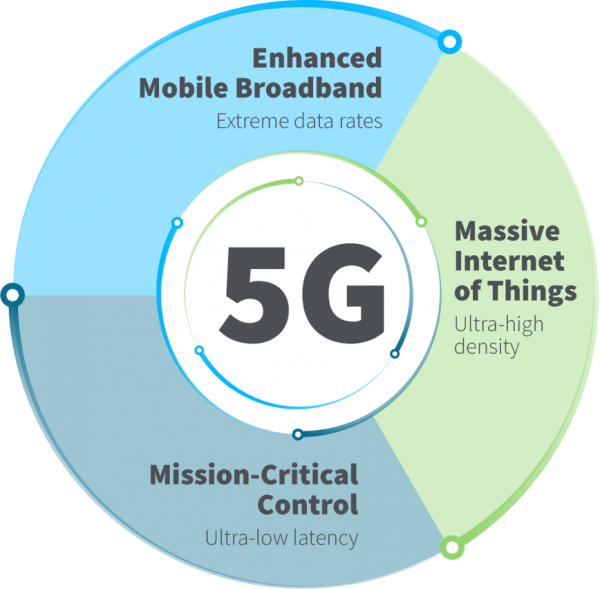
5G networks are part of a major digital transformation trend that is impacting consumer and commercial spaces. New devices and applications are emerging on the market that take advantage of the dramatically reduced latency and much higher throughput that 5G offers. It’s an exciting time. Like with previous generations, consumers are leading the 5G adoption, followed by commercial, industrial, government and medical markets.
How Does 5G Deliver Higher Speed and Lower Latency?



5G is the fifth generation of cellular network technology, and is currently under deployment globally. It runs on radio frequencies ranging from below 1 GHz all the way up to very high frequencies, called “millimeter wave” (or mmWave). The combination of these frequencies provides nationwide coverage, massive capacity and multi-Gigabit peak rates, along with ultra-low latency. The lower the frequency, the farther the signal can travel. The higher the frequency, the more data it can carry. Here are the three frequency bands that are the foundation for 5G networks:
The 5G high-band, also called mmWave, describes the highest frequencies of 5G, ranging from 24 GHz up to 100 GHz. 5G mmWave coverage is limited, because these high frequencies cannot readily move through walls, windows, or foliage and therefore are short range in nature. They do require significantly more cellular infrastructure to provide coverage.
The 5G mid-band is new spectrum in the 2-6 GHz range that was more recently opened up for 5G communication. The mid-band provides a capacity layer for urban and suburban areas, with peak rates in the 100’s of Mbps.
The 5G low-band is existing spectrum below 2 GHz that is used today for 4G LTE. It provides a nation-wide coverage layer, and multiple carriers have announced availability of low-band 5G networks. However, since the spectrum is used for 4G LTE today and the available spectrum is very limited, the performance will be similar to 4G LTE, and initially it may actually be lower. However, it offers an opportunity for eager adopters to try out 5G devices.
How Can Your Business Prepare for 5G?
Digi supports enterprises, municipalities and industrial outfits today with Gigiabit-Class LTE – the stepping stone to 5G that optimizes their investment today while helping them to prepare and seamlessly migrate to future technologies. Not only will LTE and 5G operate together on the same networks, but Digi solutions are designed with your upgrade path in mind, so you never have to fear that an investment today will be obsolete tomorrow.
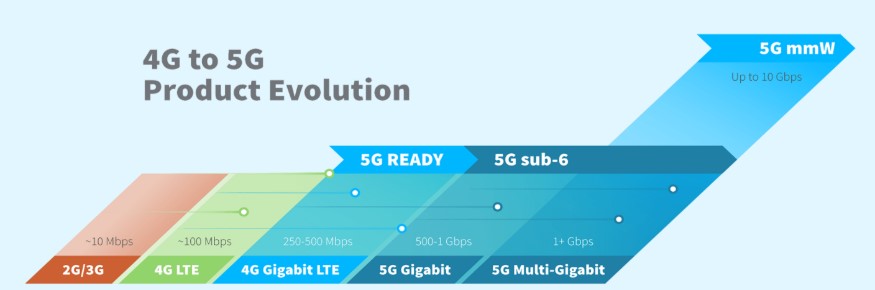 Today there are multiple ways to prepare for 5G. In the commercial, industrial and government spaces, the full rollout will be a lengthier process than in the consumer space. Therefore, it is important to plan carefully. Here are a few key points we regularly share with customers to arm them with the best possible knowledge:
4G LTE is the current generation of cellular technology that is widely deployed. LTE stands for Long Term Evolution, and describes a technology that has evolved and will continue to evolve since it was launched over a decade ago. It is affordable and safe to invest in now, as the supporting devices and networks are. proven and the networks have at least a 10-year lifecycle ahead.
5G is the next generation of cellular technology and while first 5G networks and devices are available, they will continue evolving over many years to come.
5G Use Cases
The use cases for 5G range from applications requiring high throughput to those needing high speed, beyond what current LTE networks offer. These include:
High availability, low latency use cases (Ultra Reliable Low Latency Communication or uRLLC applications): These include applications that require near instantaneous communications, such as autonomous (self-driving) vehicles, connected vehicle – an application that will automatically brake cars to prevent accidents and injuries – and industrial automation, in which emerging technologies such as artificial intelligence and machine learning will be utilized for electronic object recognition and decision making.
Massive IoT use cases (Massive Machine Type Communication or mMTC applications): These include applications that can rely on small data packets, which include smart wearables, connected fitness bands and home automation use cases. These are applications you can see today, enabled by network technologies such as NB-IoT and LTE-M, which are the forerunners of 5G for mMTC, and which will be enhanced with the development of 5G over time.
High speed use cases (Enhanced Mobile Broadband or eMBB applications): These applications include anything where a faster connection supports the desired performance, including streaming and high definition video, 360 degree video and other data-intensive and image-intensive use cases. We will see highly interactive applications in a range of use cases from gaming to flight simulation and training to precision medical applications, as well as enhanced mobile broadband services to support the needs of users in public transit.

