
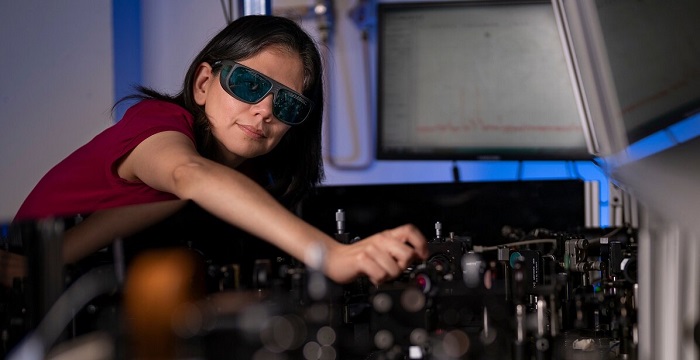
Researchers from The Australian National University (ANU) have developed a new technology that allows people to see clearly in the dark, revolutionizing night-vision.
The first-of-its-kind thin film is ultra-compact and one day could work on standard glasses.




The researchers say the new prototype tech, based on nanoscale crystals, could be used for defense, as well as making it safer to drive at night and walking home after dark.
The team also say the work of police and security guards—who regularly employ night vision—will be easier and safer, reducing chronic neck injuries from currently bulk night-vision devices.
“We have made the invisible visible,” lead researcher Dr Rocio Camacho Morales said.
This technology is able to transform infrared light, normally invisible to the human eye, and turn this into images people can clearly see—even at distance.
The team has made a very thin film, consisting of nanometre-scale crystals, hundreds of times thinner than human hair, that can be directly applied to glasses and acts as a filter, allowing you to see in the darkness of the night.
The technology is extremely lightweight, cheap and easy to mass-produce, making them accessible to everyday users.
Currently, high-end infrared imaging tech requires cryogenic freezing to work and are costly to produce. This new tech works at room temperatures.
This is the first time anywhere in the world that infrared light has been successfully transformed into visible images on an ultra-thin screen.
It’s a really exciting development and one that we know will change the landscape for night vision forever.
Mohsen Rahmani, the Leader of the Advanced Optics and Photonics Lab in Nottingham Trent University’s School of Science and Technology, led the development of the nanoscale crystal films.
“We previously demonstrated the potential of individual nanoscale crystals, but to exploit them in our everyday life we had to overcome enormous challenges to arrange the crystals in an array fashion,” he said.

