
Researchers have developed a technique for the first time that allows single-crystal hybrid perovskite materials to be integrated into electronics. Because these perovskites can be synthesized at low temperatures, the advance opens the door to new research into flexible electronics and potentially reduced manufacturing costs for electronic devices.
An international team of researchers has developed a technique that, for the first time, allows single-crystal hybrid perovskite materials to be integrated into electronics. Because these perovskites can be synthesized at low temperatures, the advance opens the door to new research into flexible electronics and potentially reduced manufacturing costs for electronic devices.




Hybrid perovskite materials contain both organic and inorganic components and can be synthesized from inks, making them amenable to large-area roll-to-roll fabrication. These materials are the subject of extensive research for use in solar cells, light-emitting diodes (LEDs) and photodetectors. However, there have been challenges in integrating single-crystal hybrid perovskites into more classical electronic devices, such as transistors.
Single-crystal hybrid perovskites are preferable because single-crystalline materials have more desirable properties than polycrystalline materials; polycrystalline materials contain more defects that adversely affect a material’s electronic properties.
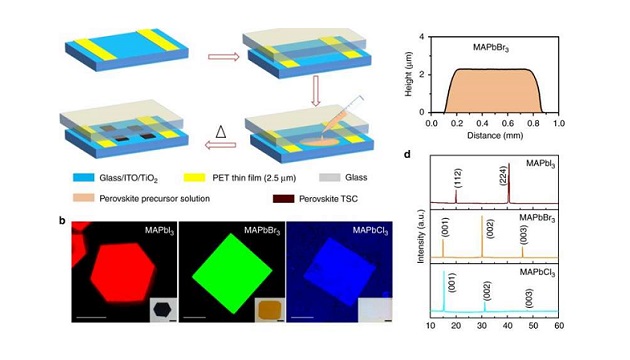
The researchers got around this problem by synthesizing the hybrid perovskite crystals between two laminated surfaces, essentially creating a single-crystal hybrid perovskite sandwich. The perovskite conforms to the materials above and below, resulting in a sharp interface between the materials. The substrate and superstrate, the “bread” in the sandwich, can be anything from glass slides to silicon wafers that are already embedded with electrodes, resulting in a ready-made transistor or circuit.
“We have demonstrated the ability to create working field-effect transistors using single-crystal hybrid perovskite materials fabricated in ambient air,” says Aram Amassian, corresponding author of a paper on the work and an associate professor of materials science and engineering at NC State.
“That’s of interest because traditional single-crystal materials have to be manufactured in ultra-high vacuum, high-temperature environments, and often require exquisite epitaxial growth,” Amassian says. “Hybrid perovskites can be grown from solution, essentially from an ink, in ambient air at temperatures below 100 degrees Celsius. This makes them attractive from a cost and manufacturing standpoint. It also makes them compatible with flexible, plastic-based substrates, meaning that they may have applications in flexible electronics and in the internet of things (IoT).

