
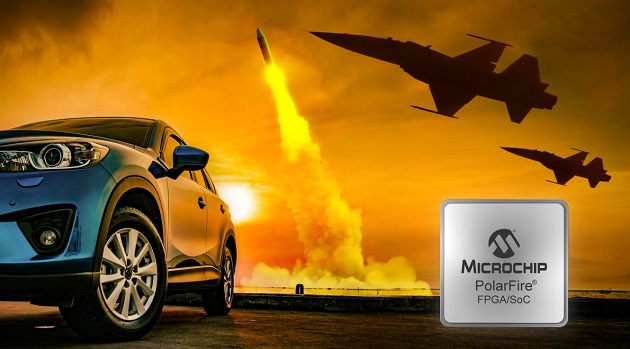
Automotive, Defense, aerospace and industrial designers who need automotive- and defense-grade programmable logic solutions can now order PolarFire Field Programmable Gate Arrays (FPGAs) in volume production quantities. Microchip Technology announced it is shipping PolarFire FPGAs qualified for both the Automotive Electronics Council Q100 (AEC-Q100) specification Grade T2 (-40°C to 125°C TJ) and military temperature grade (-40°C to 125°C TJ).
These offerings extend Microchip’s low-power leadership as a supplier of FPGAs for diverse high-reliability markets. With their thermal and space design constraints, automotive, industrial and military applications deployed in harsh environments require solutions that offer power and space efficiency as well as cryptographic security. PolarFire FPGAs offer on-chip security features that enable secure communication, an encrypted bitstream, and a cryptographically secured supply chain, ensuring tamper-proof solutions for these market segments.




Unlike SRAM-based FPGAs, Microchip devices can operate without fans and in some cases without heatsinks, simplifying the thermal design of the system and creating new opportunities for smaller, lighter designs. This is especially important in automotive applications such as blind spot detection, lane change warning systems and back up cameras. Additionally, the extended temperature range of our military grade devices coupled with our state-of-the-art security enables developers to trust and add more compute power within a thermally constrained environment such as those found in advanced strategic weapons systems.
“Removing heat from a system is not free,” said Bruce Weyer, vice president of Microchip’s FPGA business unit. “The less heat you move, the lower your total system costs become. In some cases, complete removal of fans from systems, which often have a low mean time between failure, is possible. Automotive and aerospace design engineers can now develop mid-range FPGA solutions with the lowest total power, highest reliability, and best-in-class security technologies, all at a lower total system cost.”
Availability
PolarFire automotive- and military-grade FPGAs are available in volume production. They are supported by development boards, Microchip’s Libero® software tool suite, VectorBlox™ Accelerator Software Development Kit and IP, plus Microchip’s High-Level Synthesis (HLS) tool for edge compute solutions.
For more information, visit www.microchip.com

