
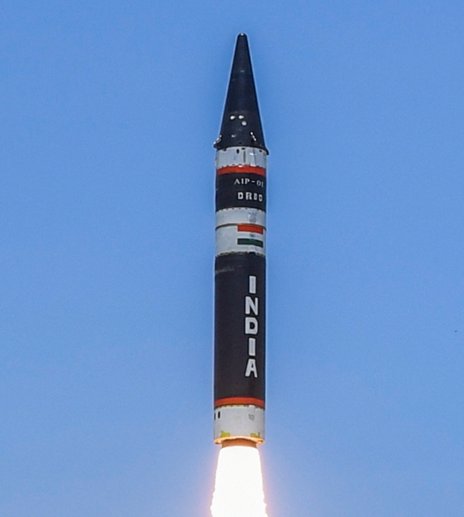
A few years ago China using a ballistic missile shot down a satellite in low-Earth, DRDO officials in India had only four words ” we can do that ” and in a matter of few years, DRDO using PDV Mk-II anti-ballistic missile showcased exactly what the Chinese had demonstrated a few years earlier, but by that time Chinese already tested DF-21D, the world’s first anti-ship ballistic missile, and yesterday, India just again demonstrated why it’s not far away from developing its own Anti-Ship Ballistic Missile (ASBM) system after it tested all new Agni-P (Prime) that is not just mear successor to the older Agni-I SRBM but much more than advertised.
The Two-Stage solid fueled Agni P (Prime) uses an all-composite structure that includes the casing that not only reduces its weight considerably by also improves its range. Agni-P (Prime) in side by side comparison looks like a mini-variant of the bigger Agni-V and actually, it does incorporate many of the technologies that were exclusively developed for the Agni-V program that includes, first for India of integrating hermetically sealed tandem twin canister made of composite materials that allow easier storage of missiles and quicker salvo launches but also makes it a tad difficult for the satellite to pick them up when on the move. Agni-P (Prime) also features a ring laser gyro-based inertial navigation system (INS) and a modern micro-navigation system (MINS) borrowed from Agni-V.



More Than What Meets the Eye
DRDO in its Press Release said that the missile is a next-generation Agni MRBM (Medium Range Ballistic Missile) that has a range of 1000 to 2000km that could vary as per payload and it is estimated that it will be able to carry 1.5 tons payload to its max range of 2000km and even more with lighter payload. A notable feature of the Agni-P (Prime) is four delta fins for terminal maneuver indicating maneuvering warheads that can defeat not only ballistic missile defense system but also be used as an Anti-Ship Ballistic Missile (ASBM) when a new variant is developed based on the Agni-P (Prime).
Not many Indian defense pundits are buying it as just a next-generation Agni MRBM that will replace older Agni-1 generation missiles but also will be developed as an Anti-Ship Ballistic Missile (ASBM) system that adds another dimension to the threat to Chinese carrier battle groups, so Agni-P (Prime) development alone can be seen as India sending a clear message of China’s increasing military confidence in the region.
Impact on Indian Ocean Region (IOR)
ASBMs effectiveness in practice hinges on a comprehensive reconnaissance and targeting architecture that includes seaward-looking ISR with an array of air, land, sea, and space-based collection assets that can guild a missile in its terminal phase even against an aircraft carrier that is moving or makes aggressive maneuvers to avoid being hit. India is piecing together the missing pieces in India’s defense jigsaw puzzle that includes the ability to track Ballistic Missile launches using space and ground-based long-range sensors and India is also putting together systems that can effectively demonstrate deployment of the ASBMs when required. . A conventionally armed ASBM is designed to take advantage of its ballistic trajectory through the upper atmosphere to propel its warhead to hypersonic speeds so that they can penetrate any shipboard anti-ballistic missile (ABM) system that its targets have fielded.
Indian Navy sure requires its land based ASBMs that once fired in salvos could give the Indian Navy not only the ability to deny access to the sea but also act as deterrence to any Chinese confidence in taking out Indian carrier battle groups. ASBMs are technically not designed to sink aircraft carriers or their Armitage but it’s used for “mission kill” and the warheads atop them are only part of a larger kill chain that will make a carrier unable to conduct flight operations, that’s the main objective.

