

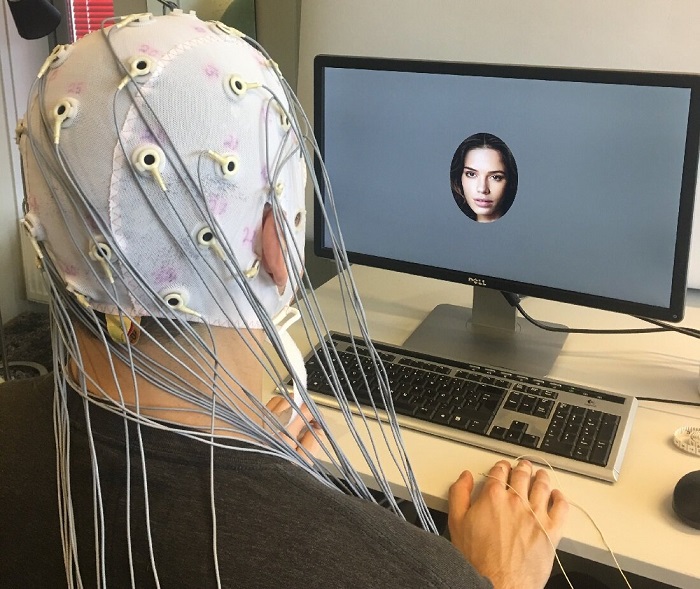
A research team from the University of Copenhagen and the University of Helsinki demonstrates it is possible to predict individual preferences based on how a person’s brain responses match up to others. This could potentially be used to provide individually-tailored media content—and perhaps even to enlighten us about ourselves.
We have become accustomed to online algorithms trying to guess our preferences for everything from movies and music to news and shopping. This is based not only on what we have searched for, looked at, or listened to but also on how these activities compare to others. Collaborative filtering, as the technique is called, uses hidden patterns in our behavior and the behavior of others to predict which things we may find interesting or appealing.



But what if the algorithms could use responses from our brain rather than just our behavior? It may sound a bit like science fiction, but a project combining computer science and cognitive neuroscience showed that brain-based collaborative filtering is indeed possible. By using an algorithm to match an individual’s pattern of brain responses with those of others, researchers from the University of Copenhagen and the University of Helsinki were able to predict a person’s attraction to a not-yet-seen face.
“Through comparing the brain activity of others, we’ve now also found it possible to predict faces each participant would find appealing prior to seeing them. In this way, we can make reliable recommendations for users—just as streaming services suggest new films or series based on the history of the users,” explains senior author Dr. Tuukka Ruotsalo of the University of Copenhagen’s Department of Computer Science.
Towards mindful computing and greater self-awareness
Industries and service providers are more and more often giving personalized recommendations and we are now starting to expect individually tailored content from them. Consequently, researchers and industries are interested in developing more accurate techniques for satisfying this demand. However, the current collaborative filtering techniques which are based on explicit behavior in terms of ratings, click behavior, content sharing, etc. are not always reliable methods of revealing our real and underlying preferences.
“Due to social norms or other factors, users may not reveal their actual preferences through their behavior online. Therefore, explicit behavior may be biased. The brain signals we investigated were picked up very early after viewing, so they are more related to immediate impressions than carefully considered behavior,” explains co-author Dr. Michiel Spapé.
“The electrical activity in our brains is an alternative and rather untapped source of information. In the longer term, the method can probably be used to provide much more nuanced information about people’s preferences than is possible today. This could be to decode the underlying reasons for a person’s liking of certain songs—which could be related to the emotions that they evoke,” explains Tuukka Ruotsalo.
“I consider our study as a step towards an era that some refer to as ‘mindful computing’, in which, by using a combination of computers and neuroscience techniques, users will be able to access unique information about themselves. Indeed, Brain-Computer Interfacing as it is known could become a tool for understanding oneself better.”
Nevertheless, there is still a way to go before the technique can be applied beyond the laboratory. The researchers point out that brain-computer interface devices must become cheaper and easier to use before they find themselves in the hands or strapped to the heads of casual users. Their best guess is that this will take at least 10 years.
The researchers also underscore that the technology comes with a significant challenge for protecting brain-based data from misuse and that it is important for the research community to carefully consider data privacy, ownership, and the ethical use of raw data collected by EEG.
In the experiment, participants were shown a large number of images of human faces and asked to look for those that they found attractive. While doing so, their brain signals were recorded. This data was used to train a machine learning model to distinguish between the brain activity when the participant saw a face that they found attractive versus when they saw a face that they did not find attractive.
With a different machine learning model, the brain-based data from a larger number of participants was used to calculate which new facial images each participant would find attractive. Thus, the prediction was based partly on individual participant’s own brain signals and partly on how other participants responded to the images.

