
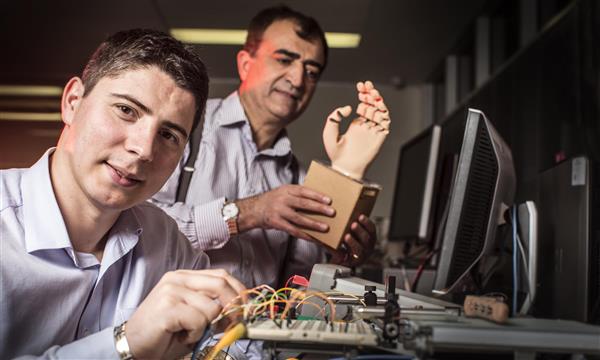
Researchers at the University of Wollogong (UOW) in Australia, working on soft robotics, have developed a 3D printed a realistic robotic hand, that is controlled by brain signals with a surface texture similar to human skin.
With the ever-going technology modification, prosthetic arms are witnessing newer innovations. Brain signals controlling, real human limbs look-alike, and smart enough to perform complex movements, are amongst some of the efficiencies found in today’s robotic body parts.




It’s not often, however, that you get all those perks in one device. For making the devices economical, many prosthetics sacrifice has to be made for function, or vice versa, depending on the user and the purpose of the device. A prosthesis just unveiled by researchers at UOW in Australia is therefore somewhat remarkable: the soft robotic hand has a surface texture just like human skin and can be controlled with brain signals thanks to its myoelectric construction.
The remarkable 3D printed prosthesis was developed at UOW by a team that included Professor Gursel Alici (lead researcher) and Dr Rahim Mutlu and was unveiled at an international electromaterials symposium at the university’s Innovation Campus. The arm responds to signals from the brain through an interface attached to arm muscles, allowing users of the device to move the prosthetic as though it were part of their body.
“The hand is one of the most important parts of our body: it’s the most significant interface between a person and their environment,” Alici said. “We have used the progress in smart, functional materials to create a robotic hand that has a better interface and interaction with the environment and allows the user to make more lifelike movements.”
The researchers behind the new prosthetic hand say that 3D printing and other advanced production equipment allowed them to create a prosthesis that is soft to the touch but also strong enough to carry heavy objects—despite being incredibly lightweight and requiring little power. 3D printing also allowed the hand to be printed as a complete piece, rather than in several parts that would produce unsightly seams once assembled. The same technique could also be applied to bionic ears, cartilage, and corneal regeneration.
The UOW team says the 3D printed soft robotic hand could be available to the general public in as little as two years time. Before then, however, there is still plenty of time to make improvements to the design. “We will be making it even more user-friendly by creating a minimally invasive interface from the brain to the nerves, from the nerves to the muscles, from the muscles to the hand and fingers,” Alici said. “So options like an implantable interface, or soft printable material on the arm instead of wires and electrodes.”
Other features that the researchers plan to introduce include smart materials that could help users grip objects more securely, as well as providing real-time feedback on object size, shape, and temperature.
Last year, Alici and Mutlu built a set of interchangeable 3D printed prosthetic arms for Len Snowden, a 54-year-old Australian man who lost his arm, leg, and hip in a workplace train accident. Their newly unveiled soft robotic hand signals an upgrade on Snowden’s prostheses.

