
HomeNewsBending Light with Vortex Ring Using Mirrors, Lasers and Lenses

    Bending Light with Vortex Ring Using Mirrors, Lasers and Lenses

    A team of researchers from the University of Shanghai for Science and Technology and the University of Dayton has developed a way to bend light into a vortex ring using mirrors, lasers, and lenses. The group built on work done by other teams in which vortex rings were observed incidentally, and then mathematically designed a system that could generate them on demand.

    In 2016, another team of researchers discovered that under the right circumstances, strong pulses of light swirling around a central pipe-shaped pulse could sometimes form into a donut-shaped vortex. Intrigued by the finding, the researchers with this new effort began to wonder if it might be possible to create such vortex rings on demand.

    They started by studying the properties and conditions that had led to the formations observed by the team in 2016 and applied mathematics to the problem. They found solutions that appeared to show how such rings could be made—solutions to Maxwell’s equations, in particular, they found, could be used to generate the kind of conformal mapping required.

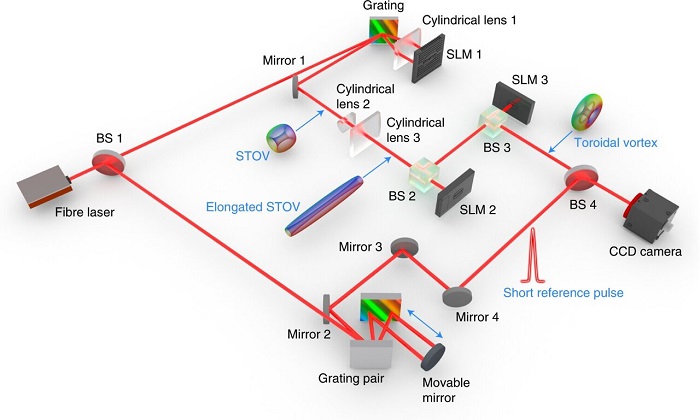
    The researchers put together a combination of materials that would lead to the real-world implementation of their math solutions. They started by modifying a standard laser to generate a specific type of pulse. They added mirrors, lenses, gratings, and special types of liquid crystal screens for the pulses to pass through. Each of the parts impacted the light in a specific way.

    The researchers note that the system first changed the pulses of light into a long, narrow shape, which gave other parts of the light something to swirl around. After the other light traveled through the system, the swirling light joined, like winds in a tornado, forming a ring.

    The researchers plan to continue their work, hoping to learn whether other vortex shapes can be made. They note that their work could provide blueprints for others looking to better understand the formation of toroidal vortices that form naturally.

    ELE Times News
    ELE Times Newshttps://www.eletimes.ai/
    ELE Times provides extensive global coverage of Electronics, Technology, and the Market. In addition to providing in-depth articles, ELE Times attracts the industry’s largest, qualified, and highly engaged audiences, who appreciate our timely, relevant content and popular formats. ELE Times helps you build experience, drive traffic, communicate your contributions to the right audience, generate leads, and market your products favorably.

    Related News

    Must Read

    What is Fashion Tech? Providing New Product Value and Customer Experiences with Technology

    Courtesy: Murata Electronics What is fashion tech? - diverse technologies...

    Emergency Screaming Detection: How AI Recognizes Human Screams and Saves Lives

    Courtesy: Renesas Detecting human screams for help is important in...

    India’s Electronics Push: Ambition Is Clear. Execution Will Decide the Outcome

    India’s electronics story has entered a decisive phase. The...

    India on the Road to Semicon Self-Reliance with Three More Plants

    India to welcome three more semiconductor plants after PM...

    Upcoming years to Bring Boom for Semiconductors and Electronics

    Union Minister for Electronics and Information Technology Ashwini Vaishnaw...

    R&S Propels 6G Readiness With FR1–FR3 Carrier Demonstration

    Rohde & Schwarz and Qualcomm Technologies, Inc. have reached...

    ROHM and Suchi Semicon Establish a Strategic Semicon Manufacturing Partnership in India

    ROHM and Suchi Semicon have announced the establishment of...

    Keysight to Demonstrate NR-NTN devices Mobility Testing at MWC 2026 in Collaboration with Samsung

    Keysight Technologies, Inc. will demonstrate lab-based validation of new...

    ROHM Strengthens Supply Capability for GaN Power Devices

    Combining TSMC’s Process Technology to Build an End-to-End, In-Group...


