
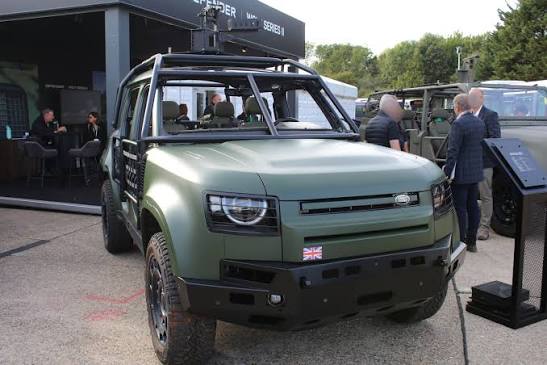
Defender has introduced three variations in its range of military mobility at DVD 2026, the British Army’s leading defence and security exhibition. The new Tactical Mobility Vehicle, Mono-Tactical Mobility Vehicle and Utility Vehicle have been created as the initial variants in a family of military vehicles that is being built through JLR’s Defender Defence Division.
Based on Defender’s dedicated D7x platform architecture, Wolf Series II adopts monocoque construction, negating the need for a traditional body-on-frame setup. JLR claims the approach delivers a more rigid platform, enables higher payloads, and provides a base for adaptation to specific military uses. The architecture is said to deliver a torsional rigidity of 29kNm per degree.




The three variants have been specified according to the UK Ministry of Defence Light Mobility Vehicle tender specifications. Defender expects to be able to supply the platform to NATO defence agencies. In addition to the three variants, other possible configurations include a general-purpose platform, command-and-control vehicle and battlefield ambulance. JLR says the Defender platform has undergone over 62,000 engineering sign-off tests, traversed deserts, snow and ice caps, high altitude environments and extreme off-road conditions.
In addition to military radios, sensors, electronic countermeasures, command and external power systems, the platform could also carry other items depending upon what the customer may want. For readers in India, the programme is more important as JLR is owned by Tata Motors Passenger Vehicles. Wolf Series II shows how a commercially derived platform can be emplaced, electronically configured, and manufactured for today’s needs of tactical operations.

