
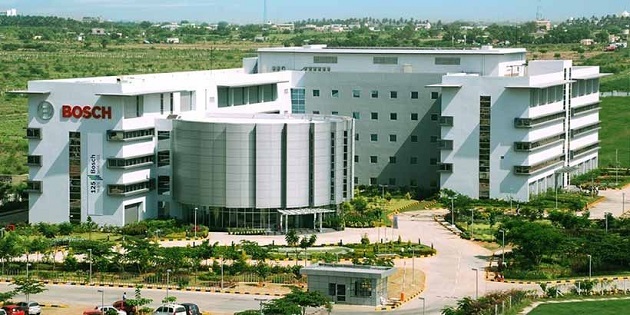
Seeing the huge opportunities in future technologies like Internet of Things (IoT), and Artificial Intelligence (AI), German auto component makers Bosch is amid talks to hire over 10,000 engineers from India for its R&D centres in the country.
Media reports claim that the firm is planning to invest in excess of Rs 800 crores over the next couple of years in India to expand its facilities here, including R&D centres for future technologies.




“We spend a lot of money on IoT, especially to provide mobility solutions, and we see a strong future in this area,” Bhattacharya said. “Today, the car is looked at as the third living space after one’s office and home. Bosch is making for connected, automated and shared vehicles. Just from your car, you will have an equal form of connectivity as you can have from the office or home.”
Incidentally, Bosch’s second largest R&D facility is located in India. Located in Karnataka’s capital Bengaluru the facility currently employs more than 18,000 engineers.
While India’s contribution to Bosch’s total revenue is as low as 3 per cent, the Indian peninsula has become a strategic market for the German company as a technology development centre.
Apart from its upcoming R&D centres, the auto parts maker is also looking at expanding into the electric vehicle segment as well.
“The Bosch global board has yet to take a decision whether we will go into actual manufacturing or outsource batteries for EVs … as I said we are fully there and a decision on battery will be made soon,” the Bosch India chief said added.
The company, which has a substantial share of revenue coming up from the conventional internal combustion engines, though, doesn’t expect electric vehicles becoming too big a segment in the near future.
“Internal combustion engine, gasoline, CNG or ethanol will have a long lasting time. It is very much worthwhile to invest in any kind of efficiency improvement in these engines,” said Jan Oliver Rohrl, the German company’s chief technology officer.
According to Bosch, by 2030, pure EVs would comprise only 10% of total vehicles globally. Even in a bestcase scenario, according to it, EVs would not exceed 18% of the total.
“While EV will leapfrog and grow into a substantial number, yet ICE will still remain a very dominant technology for mobility,” said Bhattacharya.
Implementation of the Bharat Stage VI emission rules in 2020 and the RDE (Real time Driving Emission) norms later will help India substantially improve on emission standards, he said.

