
In many two-dimensional (2D) materials, electrons not only possess charge and spin but further exhibits an unusual quantum feature is known as “valley.” Simply speaking, electrons residing in many 2D materials can live in well-separated energy minima, and the “address” describing which minima these electrons belong to is known as “valley.” The use of this “valley address” to encode and process information forms the core of a new vibrant research field known as “valleytronics.”
Despite much anticipation of valleytronics being a candidate for ‘beyond CMOS’ technology and to continue the legacy of Moore’s law, its progress is severely hindered by the lack of practical designs for a valleytronic-based information processing unit. One major challenge in valleytronic is the construction of a “valley filter.” Valley filter can produce electrical current composed dominantly of electrons from only one specific “valley.” It serves as a fundamental building block in valleytronics.




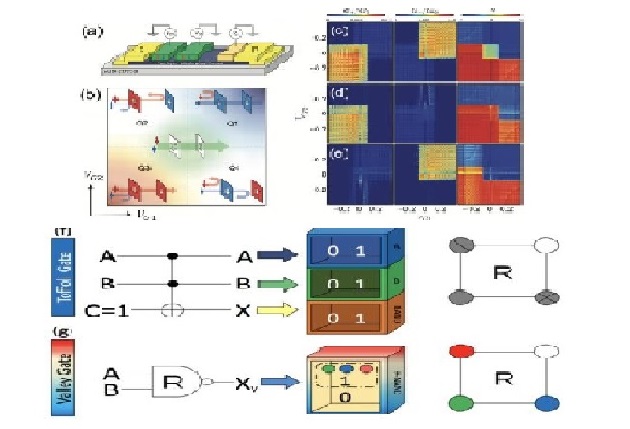
By harnessing the unusual electrical properties of 2D materials such as few-layer black phosphorus and topological Weyl/Dirac semimetal thin films, researchers from the Singapore University of Technology and Design (SUTD) designed a versatile all-electric-controlled valley filter and demonstrated, for the first time, a concrete working design of valleytronic logic gate capable of performing the full set of two-input Boolean logics.
“A particularly remarkable finding is a previously unexplored approach of achieving logically-reversible computation by storing information in the electron’s valley state,” said first-author Dr. Yee Sin Ang from SUTD.
Conventional digital computers process information in a logically-irreversible fashion. This leads to a serious logical issue — upon receiving a computational output, an end-user cannot unambiguously identify the original input information that produces this output.
Making digital computing logically-reversible is not only interesting in terms of fundamental information science, but also has broad applications in areas such as cryptography, signal and image processing, quantum computing, and is ultimately required to improve the energy efficiency of digital computers beyond the thermodynamic bottleneck also known as Landauer’s limit. Due to its immense potentials, enormous research efforts have been devoted to the search for a practical reversible computer since the 1970s.
The traditional way of making a logically-reversible computer relies heavily on complex circuitries that inevitably generate large quantities of wasteful bits. These complex and wasteful methods have prevented reversible computing from gaining widespread industrial and commercial interests.
The key novelty of the valleytronic-based reversible logic gate proposed by SUTD researchers is that the device stores additional bits of input information in the valley state of the computational output to achieve logical-reversibility. This valleytronic approach bypasses the need of complex circuitries and significantly reduces the generation of wasteful bits. Such simple architecture is also more compatible with the ever-growing industrial and commercial demands for compact smart devices with ever-shrinking physical sizes.
Co-author and principal investigator of this research, SUTD Prof Ricky Ang, said: “The union of valleytronics, digital information processing and reversible computing may provide a new paradigm towards the future of ultimately energy-efficient computer with novel functionalities.”
Article Courtesy: Science Daily

