

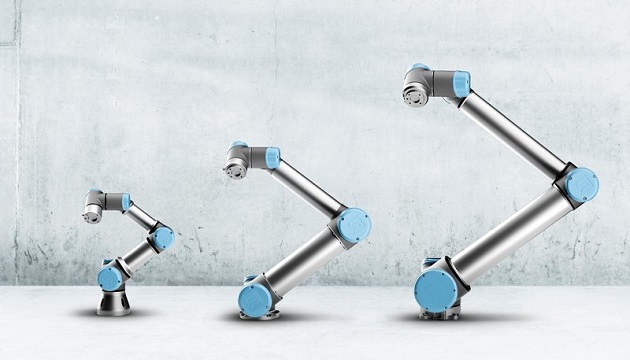
Universal Robots, a Danish robot manufacturer of advanced user-friendly and light industrial robotic arms collaborated with G+D (Giesecke + Devrient), the market leaders in Bank Note Processing in India. These collaborative robots safely work alongside humans, and more as a ‘helping hand’ or ‘portable tool’ which traditional industrial robots cannot be used as.
After deploying their cobots in automotive industry, FMCG, Electronics, Education and R&D Centres, Universal Robots established their presence in the banking sector. G+D (Giesecke + Devrient), the market leaders in Bank Note Processing in India for over two decades have collaborated with Universal Robots in 2015 and deployed the UR3 for pick and place processes in the currency chests.



Universal Robots along with G+D (Giesecke + Devrient) organized a press conference on 17th May 2018 at The Oberoi, New Delhi. Speaking on the occasion, Vivek Shankar, Deputy Managing Director, G+D India Pvt. Ltd. said, “In 2015, we chose robots from Universal Robots because these robots turned out to be the ‘best suitable technology.’ The UR3 which was a compact, small robot fit in the space we were looking for. It was fast and accurate as it could be programmed to do what was exactly needed. The user has to feed the machine just once and the robotic system does everything else for them. The UR3, because of its size, could reach all pockets of the machine to pick the cash, put it in for banding and then on the conveyer belt for bundling.”
Pradeep David, General Manager, Universal Robots, South Asia said, “The collaborative robot is a powerful innovation in the industrial manufacturing sector, enabling automated production with unprecedented flexibility. Our collaborative robot arms automate and streamline repetitive industrial processes. This approach will enable production departments to assign their staff members more creative jobs that provide them with new challenges that add value to the company and at the same time increase the efficiency and productivity. We are proud to be associated with G+D (Giesecke + Devrient) since 2015. Universal Robots has now ventured into the banking sector and inclusion of collaborative robots in the banking sector will prove to be game – changing. We would like to thank our channel partner Encon Systems for their dedication and strong engineering skills in the development of this unique project.”
G+D (Giesecke + Devrient) is a global company that offers security technologies, both in the physical and digital spheres, with their Headquarters in Munich, Germany. They have been closely associated with the Reserve Bank of India (RBI) since 2005.
The emerging trend in 2015 was the increasing interest of commercial banks to automate cash centers. Seeking a solution that could be scaled down to handle medium-sized cash centers, Giesecke + Devrient (G+D) turned to Universal Robots to deploy the UR3 proved to be a holistic solution which increased efficiency, optimized processes, and enhanced security – all in a constrained space.
The processing capacity is 10 – 12 bank notes per second, which means that it processes 30,000 bank notes per hour.

